
Export/Import/Edit etcd directory as JSON/YAML/TOML and validate directory using JSON schema.
Use cases
- Backup/Restore in a format which is not database or version specific.
- Migration of data from production to testing.
- Store configuration in Git and use import to populate etcd.
- Validate directory entries using JSON schema.

jsonschema is an implementation of the JSON Schema specification for Python.
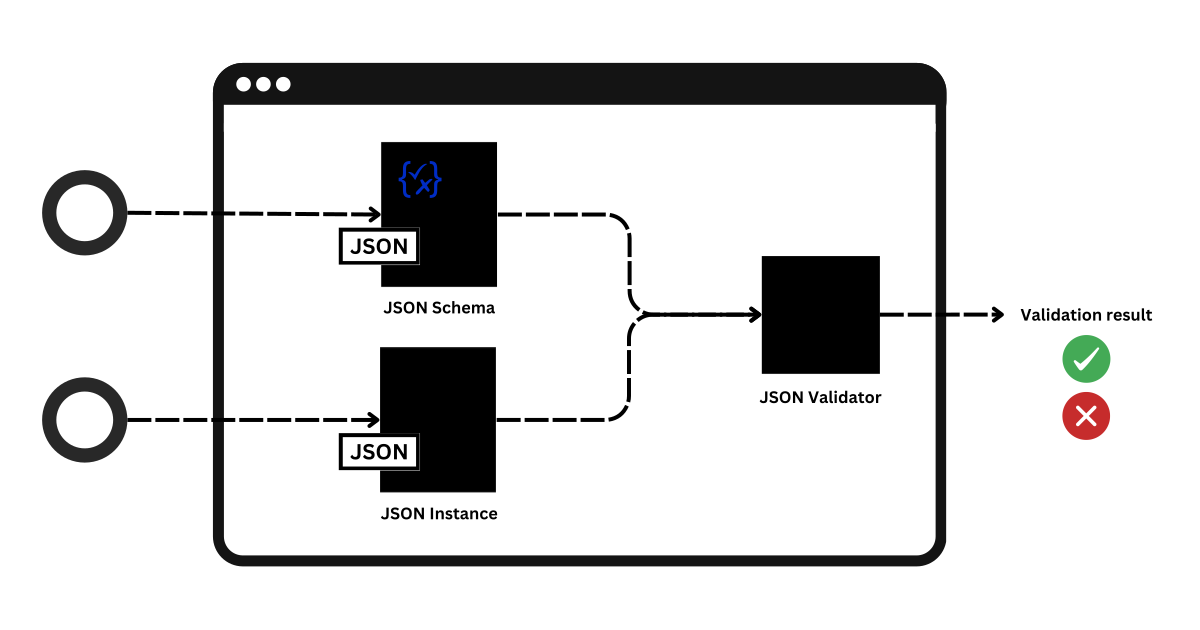
When it comes to data exchange, JSON Schema stands out as a powerful standard for defining the structure and rules of JSON data. It uses a set of keywords to define the properties of your data.
While JSON Schema provides the language, validating a JSON instance against a schema requires a JSON Schema validator. The JSON validator checks if the JSON documents conform to the schema.
JSON Schema Validators are tools that implement the JSON Schema specification. Such tooling enables easy integration of JSON Schema into projects of any size.


API Connector enables the use of JMESPath, which is a powerful query language for JSON with many useful applications:
- filter for certain fields in the response data
- filter for records that meet specified conditions
- change the report structure, for example to convert columns to rows or normalize JSON
If you just want to filter out fields from your report, you can use API Connector's visual field editor. However, if you're interested in more powerful filtering capabilities, read ahead for information on using JMESPath expressions in your requests.


jq is like sed for JSON data - you can use it to slice and filter and map and transform structured data with the same ease that sed, awk, grep and friends let you play with text.
gron is a self-contained Go executable you can download from here on GitHub. In the UNIX tradition, gron does one thing well: it flattens JSON into a structure that's easily processed by shell tools, line by line.
JSON Schema is a vocabulary that allows you to annotate and validate JSON documents.
Benefits
- Describes your existing data format(s).
- Provides clear human- and machine- readable documentation.
- Validates data which is useful for:
- Automated testing.
- Ensuring quality of client submitted data.
There’s an amazing amount of data available on the Web. Many web services, like YouTube and GitHub, make their data accessible to third-party applications through an application programming interface (API). One of the most popular ways to build APIs is the REST architecture style. Python provides some great tools not only to get data from REST APIs but also to build your own Python REST APIs.
In this tutorial, you’ll learn:
- What REST architecture is
- How REST APIs provide access to web data
- How to consume data from REST APIs using the requests library
- What steps to take to build a REST API
- What some popular Python tools are for building REST APIs
By using Python and REST APIs, you can retrieve, parse, update, and manipulate the data provided by any web service you’re interested in.
The Meteostat JSON API provides simple access to a large archive of historical weather and climate data. The records are queried by weather station or geo location and can be filtered by specifying a date range and other optional parameters. The API is available via this URL:
Access to the API requires users to send their API key along with every request. All API endpoints return a JSON object that contains two properties: meta and data. The meta object provides general information about the data output and debugging information. For instance, the source string which holds the names of the organizations which provided the raw data. The data property is either an object or an array that contains the actual data output.
All API endpoints are accessible using HTTP Get requests. For debugging, please utilize the HTTP status code of the response.
FastAPI is a modern, fast (high-performance), web framework for building APIs with Python 3.6+ based on standard Python type hints.
The key features are:
-
Fast: Very high performance, on par with NodeJS and Go (thanks to Starlette and Pydantic). One of the fastest Python frameworks available.
-
Fast to code: Increase the speed to develop features by about 200% to 300% *.
-
Fewer bugs: Reduce about 40% of human (developer) induced errors. *
-
Intuitive: Great editor support. Completion everywhere. Less time debugging.
-
Easy: Designed to be easy to use and learn. Less time reading docs.
-
Short: Minimize code duplication. Multiple features from each parameter declaration. Fewer bugs.
-
Robust: Get production-ready code. With automatic interactive documentation.
-
Standards-based: Based on (and fully compatible with) the open standards for APIs: OpenAPI (previously known as Swagger) and JSON Schema.
Web Services Made Easy (WSME) simplifies the writing of REST web services by providing simple yet powerful typing, removing the need to directly manipulate the request and the response objects.
WSME can work standalone or on top of your favorite Python web (micro)framework, so you can use both your preferred way of routing your REST requests and most of the features of WSME that rely on the typing system like:
Alternate protocols, including those supporting batch-calls
Easy documentation through a Sphinx extension
WSME is originally a rewrite of TGWebServices with a focus on extensibility, framework-independance and better type handling.
While exploring tooling for Kubernetes I had need for schemas to describe the definition files, and went looking for something that didn't require either kubectl or similar installed or even a working Kubernetes installation.
It turns out that the OpenAPI specification contain this information, but not in a particularly usable format for tools which might just want a raw JSON Schema.
This repository contains a set of schemas for most recent Kubernetes versions. For each specified Kubernetes versions you should find four different flavours:
vX.Y.Z - URL referenced based on the specified GitHub repository
vX.Y.Z-standalone - de-referenced schemas, more useful as standalone documents
vX.Y.Z-local - relative references, useful to avoid the network dependency
vX.Y.Z-strict - prohibits properties not defined in the schema
Note that the Kubernetes API allows additional properties to be submitted, but kubectl acts like the strict flavour above.
jsonschema is an implementation of JSON Schema for Python (supporting 2.7+ including Python 3).
Features
- Full support for Draft 6, Draft 4 and Draft 3
- Lazy validation that can iteratively report all validation errors.
- Small and extensible
- Programmatic querying of which properties or items failed validation.
JSON Web Token (JWT) is a compact, URL-safe means of representing
claims to be transferred between two parties. The claims in a JWT
are encoded as a JSON object that is used as the payload of a JSON
Web Signature (JWS) structure or as the plaintext of a JSON Web
Encryption (JWE) structure, enabling the claims to be digitally
signed or integrity protected with a Message Authentication Code
(MAC) and/or encrypted.
- JSON Web Token Claims
- JWT Confirmation Methods
JSON Web Token (JWT, sometimes pronounced /dʒɒt/[1]) is a JSON-based open standard (RFC 7519) for creating access tokens that assert some number of claims. For example, a server could generate a token that has the claim "logged in as admin" and provide that to a client. The client could then use that token to prove that it is logged in as admin. The tokens are signed by one party's private key (usually the server's), so that both parties (the other already being, by some suitable and trustworthy means, in possession of the corresponding public key) are able to verify that the token is legitimate. The tokens are designed to be compact,[2] URL-safe,[3] and usable especially in web browser single sign-on (SSO) context. JWT claims can be typically used to pass identity of authenticated users between an identity provider and a service provider, or any other type of claims as required by business processes.[4][5]
JWT relies on other JSON-based standards: JWS (JSON Web Signature) RFC 7515 and JWE (JSON Web Encryption) RFC 7516.[6][7][8]
JSON Web Tokens are an open, industry standard RFC 7519 method for representing claims securely between two parties.