Transitous is a community-run provider-neutral international public transport routing service.
Using openly available data and a FOSS routing engine we operate a free to use routing service that does not stop at borders.


The keymgr utility serves for manual key management in Knot DNS server.
Functions for DNSSEC keys and KASP (Key And Signature Policy) management are provided.
The DNSSEC and KASP configuration is stored in a so called KASP database. The database is backed by LMDB.

This utility sends Dynamic DNS update messages to a DNS server. Update content is read from a file (if the parameter filename is given) or from the standard input.
The format of updates is textual and is made up of commands. Every command is placed on the separate line of the input. Lines starting with a semicolon are comments and are not processed.
This program controls a running knotd process using a socket.
If an action is specified, it is performed and knotc exits, otherwise the program is executed in the interactive mode.
Knot DNS is a high-performance open-source DNS server. It implements only the authoritative domain name service. Knot DNS can reliably serve TLD domains as well as any other zones.
Knot DNS benefits from its multi-threaded and mostly lock-free implementation which allows it to scale well on SMP systems and operate non-stop even when adding or removing zones.
The server itself is accompanied by several utilities for general DNS operations or for maintaining the server.
For more info and downloads see www.knot-dns.cz.
uMap lets you quickly build custom maps with OpenStreetMap’s background layers and integrate them on your own website.

BlueChi (formerly known as hirte) is a deterministic multi-node service controller.
BlueChi can manage the states of different services across multiple nodes with a focus on highly regulated industries, such as those requiring functional safety. BlueChi integrates with systemd via its D-Bus API and relays D-Bus messages over TCP for multi-nodes support.
On the main node a service called bluechi-controller is running. On startup, the controller loads the configuration files which describe all the involved systems (called nodes) that are expected to be managed. Each node has a unique name that is used to reference it in the controller.
On each managed node that is under control of BlueChi a service called bluechi-agent is running. When the service starts, it connects (via D-Bus over TCP) to the controller and registers as available (optionally authenticating). It then receives requests from the controller and reports local state changes to it.
Welcome
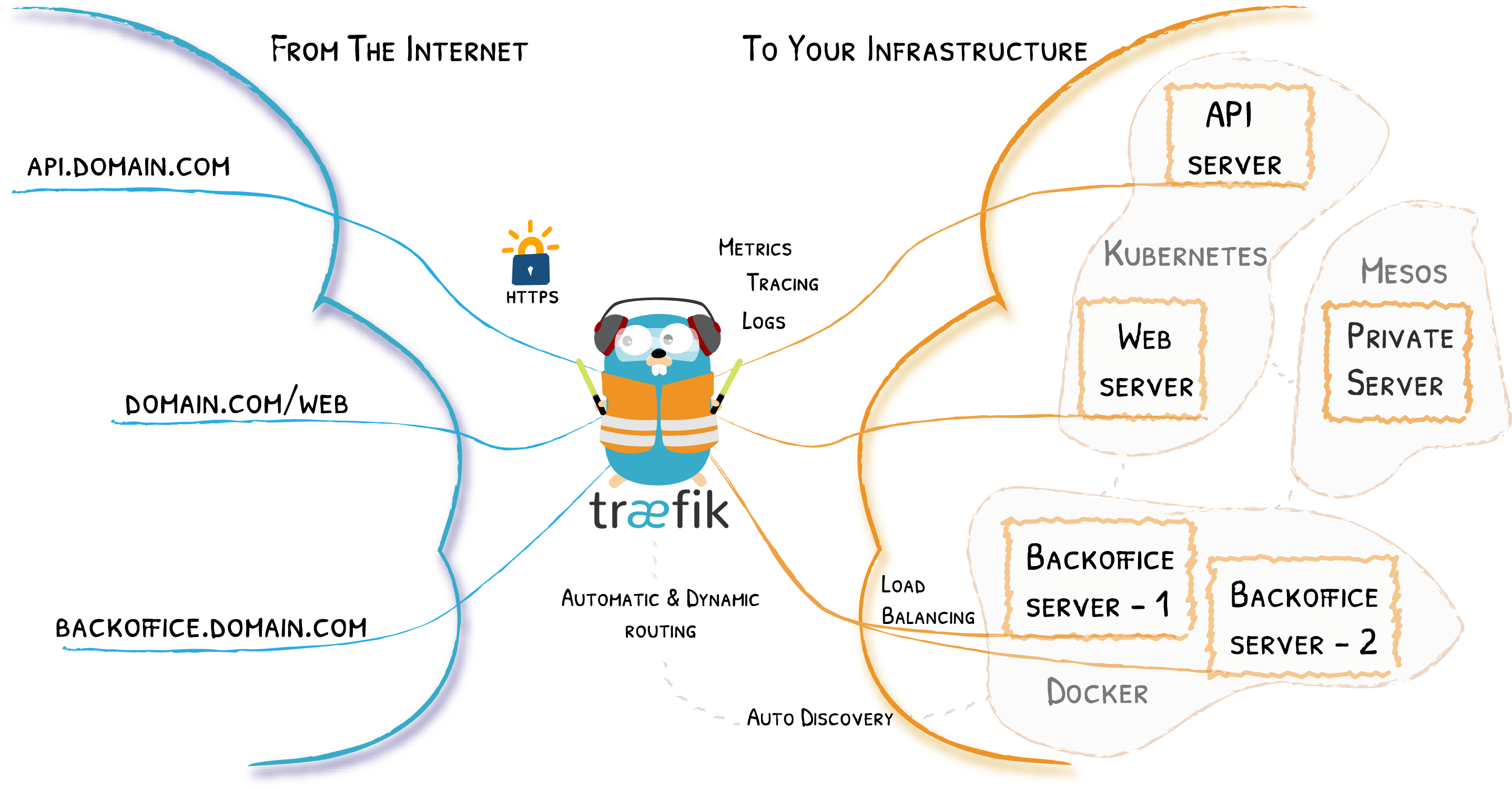
Traefik is an open-source Edge Router that makes publishing your services a fun and easy experience. It receives requests on behalf of your system and finds out which components are responsible for handling them.
What sets Traefik apart, besides its many features, is that it automatically discovers the right configuration for your services. The magic happens when Traefik inspects your infrastructure, where it finds relevant information and discovers which service serves which request.
Traefik is natively compliant with every major cluster technology, such as Kubernetes, Docker, Docker Swarm, AWS, Mesos, Marathon, and the list goes on; and can handle many at the same time. (It even works for legacy software running on bare metal.)
With Traefik, there is no need to maintain and synchronize a separate configuration file: everything happens automatically, in real time (no restarts, no connection interruptions). With Traefik, you spend time developing and deploying new features to your system, not on configuring and maintaining its working state.
Developing Traefik, our main goal is to make it simple to use, and we're sure you'll enjoy it.

Python bindings and code examples for using Varlink access to Podman Service
unAsService is a command line tool that allows you to setup a regular console application to run as a service.
This tool requires that .NET Framework 4.5 be already installed on your computer. If you do not have .NET Framework 4.5 this tool will display a message and not run.
IMPORTANT: Any services you install using this tool will require that this tool remain on that computer in the same location in order for those services to continue functioning. Therefore before installing any services you should make sure this tool is somewhere where it can remain permanently. If you do end up moving this tool use the 'fixservices' action to fix the existing services. (details on how to use 'fixservices' can be found below)
RunAsService Typing just the name of the tool without specifying any parameters. Or specifying incorrect paramters will bring you to this help screen you are currently reading.
RunAsService install [Name] [Display Name] PathToExecutable [Args] Name The name of the service, if none is specified the name will default to the name of the executable.
nssm is a service helper which doesn't suck. srvany and other service helper programs suck because they don't handle failure of the application running as a service. If you use such a program you may see a service listed as started when in fact the application has died. nssm monitors the running service and will restart it if it dies. With nssm you know that if a service says it's running, it really is. Alternatively, if your application is well-behaved you can configure nssm to absolve all responsibility for restarting it and let Windows take care of recovery actions.
nssm logs its progress to the system Event Log so you can get some idea of why an application isn't behaving as it should.
nssm also features a graphical service installation and removal facility. Prior to version 2.19 it did suck. Now it's quite a bit better.
Fabio is an HTTP and TCP reverse proxy that configures itself with data from Consul.
Traditional load balancers and reverse proxies need to be configured with a config file. The configuration contains the hostnames and paths the proxy is forwarding to upstream services. This process can be automated with tools like consul-template that generate config files and trigger a reload.
Fabio works differently since it updates its routing table directly from the data stored in Consul as soon as there is a change and without restart or reloading.
When you register a service in Consul all you need to add is a tag that announces the paths the upstream service accepts, e.g. urlprefix-/user or urlprefix-/order and fabio will do the rest.
Nowadays, identity management is everywhere and is no longer reserved for a technical audience, FusionDirectory was born from this need to make everyday identity management easy.
FusionDIrectory allows you to simplify and harmonize your identity management while focusing on security.
Add authentication to applications and secure services with minimum fuss. No need to deal with storing users or authenticating users. It's all available out of the box.
You'll even get advanced features such as User Federation, Identity Brokering and Social Login.
For more details go to about and documentation, and don't forget to try Keycloak. It's easy by design!
ArchiveBox takes a list of website URLs you want to archive, and creates a local, static, browsable HTML clone of the content from those websites (it saves HTML, JS, media files, PDFs, images and more).
You can use it to preserve access to websites you care about by storing them locally offline. ArchiveBox imports lists of URLs, renders the pages in a headless, authenticated, user-scriptable browser, and then archives the content in multiple redundant common formats (HTML, PDF, PNG, WARC) that will last long after the originals disappear off the internet. It automatically extracts assets and media from pages and saves them in easily-accessible folders, with out-of-the-box support for extracting git repositories, audio, video, subtitles, images, PDFs, and more.
FastAPI is a modern, fast (high-performance), web framework for building APIs with Python 3.6+ based on standard Python type hints.
The key features are:
-
Fast: Very high performance, on par with NodeJS and Go (thanks to Starlette and Pydantic). One of the fastest Python frameworks available.
-
Fast to code: Increase the speed to develop features by about 200% to 300% *.
-
Fewer bugs: Reduce about 40% of human (developer) induced errors. *
-
Intuitive: Great editor support. Completion everywhere. Less time debugging.
-
Easy: Designed to be easy to use and learn. Less time reading docs.
-
Short: Minimize code duplication. Multiple features from each parameter declaration. Fewer bugs.
-
Robust: Get production-ready code. With automatic interactive documentation.
-
Standards-based: Based on (and fully compatible with) the open standards for APIs: OpenAPI (previously known as Swagger) and JSON Schema.
Cornice provides helpers to build & document REST-ish Web Services with Pyramid, with decent default behaviors. It takes care of following the HTTP specification in an automated way where possible.
We designed and implemented cornice in a really simple way, so it is easy to use and you can get started in a matter of minutes.