The VMware vCenter Server APIs are organized around REST. For ease of use and security, REST builds on the standard web protocols HTTP and HTTPS, using the normal network ports 80 and 443, which are both open in most data centers, and uses standard HTTP response codes, authentication, and verbs.

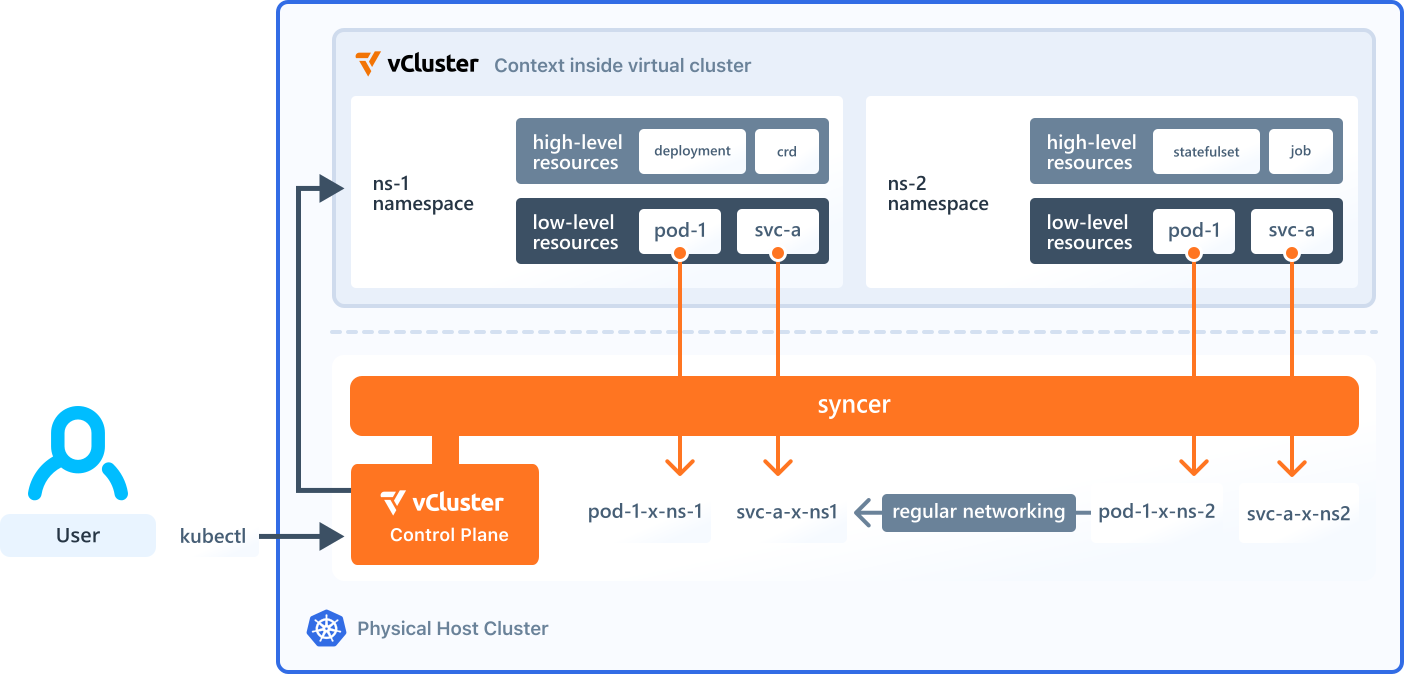
Virtual clusters are fully working Kubernetes clusters that run on top of other Kubernetes clusters. Compared to fully separate "real" clusters, virtual clusters do not have their own node pools. Instead, they are scheduling workloads inside the underlying cluster while having their own separate control plane.
Cluster API is a Kubernetes sub-project focused on providing declarative APIs and tooling to simplify provisioning, upgrading, and operating multiple Kubernetes clusters.
Started by the Kubernetes Special Interest Group (SIG) Cluster Lifecycle, the Cluster API project uses Kubernetes-style APIs and patterns to automate cluster lifecycle management for platform operators. The supporting infrastructure, like virtual machines, networks, load balancers, and VPCs, as well as the Kubernetes cluster configuration are all defined in the same way that application developers operate deploying and managing their workloads. This enables consistent and repeatable cluster deployments across a wide variety of infrastructure environments.
Welcome to the Jira Server platform REST API reference. You can use this REST API to build apps for Jira, develop integrations between Jira and other applications, or script interactions with Jira. This page documents the REST resources available in Jira Server platform, along with expected HTTP response codes and sample requests.
This part of the documentation covers all the interfaces of Requests. For parts where Requests depends on external libraries, we document the most important right here and provide links to the canonical documentation.
Kea is open source, shared under MPL2.0 licensing. Kea is developed in the open on ISC’s GitLab; we welcome you to open issues and submit patches there. Kea runs on most Linux and Unix platforms, as well as MacOS. If you don’t want to build from our source distribution, we also provide a repository of pre-built packages for most popular operating systems.
ISC distributes and maintains TWO open source, standards-based DHCP server distributions: Kea DHCP and ISC DHCP. Kea includes all the most-requested features, is far newer, and is designed for a more modern network environment.
How is the Kea DHCP server different from the older ISC DHCP?
-
Modular Component Design, Extensible with Hooks Modules. The Kea distribution includes separate daemons for a DHCPv4 server, a DHCPv6 server, and a dynamic DNS (DDNS) module. Many optional features are enabled with dynamically-loaded “Hooks Modules,” which you need run only if you are using them. You can write your own hooks modules (in C++) or try some of the hooks we offer.
-
On-line Re-configuration with REST API Kea uses a JSON configuration file that can be modified remotely via set commands and reloaded without stopping and restarting the server, an operation that could take quite a while with ISC DHCP.
-
Designed to Integrate with Your Existing Systems. Kea allows you to separate the data from the execution environment, enabling new deployment options. Your network data - leases, host reservation definitions, and most configuration data - can be located separately from the DHCP server itself, using a Kea “backend.”
-
Web-based graphical dashboard Kea now has a graphical dashboard for monitoring multiple Kea servers. This system, called Stork, uses agents deployed on the Kea servers to relay information to a centralized management platform, providing the administrator with an easy-to-use quick view of system status and activity.
Kea supports two database backends; MySQL and PostgreSQL. Choose to store leases, host reservations, or shared configuration data in a separate database backend. Benefits of this include:
-
Integrate it more easily with your other systems - provisioning systems, IPAMS and so on - by storing critical data in a separate database.
-
Use the same hosts reservations backend for multiple DHCP servers.
-
Administer global options from a centralized configuration backend.
-
Manage large address pools in a database rather than a text file.


There’s an amazing amount of data available on the Web. Many web services, like YouTube and GitHub, make their data accessible to third-party applications through an application programming interface (API). One of the most popular ways to build APIs is the REST architecture style. Python provides some great tools not only to get data from REST APIs but also to build your own Python REST APIs.
In this tutorial, you’ll learn:
- What REST architecture is
- How REST APIs provide access to web data
- How to consume data from REST APIs using the requests library
- What steps to take to build a REST API
- What some popular Python tools are for building REST APIs
By using Python and REST APIs, you can retrieve, parse, update, and manipulate the data provided by any web service you’re interested in.
dnsdist is a highly DNS-, DoS- and abuse-aware loadbalancer. Its goal in life is to route traffic to the best server, delivering top performance to legitimate users while shunting or blocking abusive traffic.
dnsdist is dynamic, its configuration language is Lua and it can be changed at runtime, and its statistics can be queried from a console-like interface or an HTTP API.

orchestrator is a MySQL high availability and replication management tool, runs as a service and provides command line access, HTTP API and Web interface. orchestrator supports:

Apache APISIX is a dynamic, real-time, high-performance API gateway.
APISIX provides rich traffic management features such as load balancing, dynamic upstream, canary release, circuit breaking, authentication, observability, and more.
You can use Apache APISIX to handle traditional north-south traffic, as well as east-west traffic between services. It can also be used as a k8s ingress controller.
signald is a daemon that facilitates communication over Signal.
The Meteostat JSON API provides simple access to a large archive of historical weather and climate data. The records are queried by weather station or geo location and can be filtered by specifying a date range and other optional parameters. The API is available via this URL:
Access to the API requires users to send their API key along with every request. All API endpoints return a JSON object that contains two properties: meta and data. The meta object provides general information about the data output and debugging information. For instance, the source string which holds the names of the organizations which provided the raw data. The data property is either an object or an array that contains the actual data output.
All API endpoints are accessible using HTTP Get requests. For debugging, please utilize the HTTP status code of the response.
We launched our Backblaze S3 Compatible APIs in May of 2020 and released them for GA in July. After a launch, it’s easy to forget about the hard work that made it a reality. With that in mind, we’ve asked Malay Shah, our Senior Software Engineering Manager, to explain one of the challenges he found intriguing in the process. If you’re interested in developing your own APIs, or just curious about how ours have come to be, we think you’ll find Malay’s perspective interesting.
FastAPI is a modern, fast (high-performance), web framework for building APIs with Python 3.6+ based on standard Python type hints.
The key features are:
-
Fast: Very high performance, on par with NodeJS and Go (thanks to Starlette and Pydantic). One of the fastest Python frameworks available.
-
Fast to code: Increase the speed to develop features by about 200% to 300% *.
-
Fewer bugs: Reduce about 40% of human (developer) induced errors. *
-
Intuitive: Great editor support. Completion everywhere. Less time debugging.
-
Easy: Designed to be easy to use and learn. Less time reading docs.
-
Short: Minimize code duplication. Multiple features from each parameter declaration. Fewer bugs.
-
Robust: Get production-ready code. With automatic interactive documentation.
-
Standards-based: Based on (and fully compatible with) the open standards for APIs: OpenAPI (previously known as Swagger) and JSON Schema.
Cornice provides helpers to build & document REST-ish Web Services with Pyramid, with decent default behaviors. It takes care of following the HTTP specification in an automated way where possible.
We designed and implemented cornice in a really simple way, so it is easy to use and you can get started in a matter of minutes.
Web Services Made Easy (WSME) simplifies the writing of REST web services by providing simple yet powerful typing, removing the need to directly manipulate the request and the response objects.
WSME can work standalone or on top of your favorite Python web (micro)framework, so you can use both your preferred way of routing your REST requests and most of the features of WSME that rely on the typing system like:
Alternate protocols, including those supporting batch-calls
Easy documentation through a Sphinx extension
WSME is originally a rewrite of TGWebServices with a focus on extensibility, framework-independance and better type handling.
Eve is an open source Python REST API framework designed for human beings. It allows to effortlessly build and deploy highly customizable, fully featured RESTful Web Services.
Eve is powered by Flask and Cerberus and it offers native support for MongoDB data stores. Support for SQL, Elasticsearch and Neo4js backends is provided by community extensions.
The codebase is thoroughly tested under Python 2.7, 3.4+, and PyPy.