Wählen Sie zwischen Acrylglas der Marke PLEXIGLAS® oder herkömmlichen Acrylglas, Dibond®, Makrolon®, PVC oder auch Aluminium Platten und geben Sie Ihr Wunschmaß ein - Wir erledigen den Rest und Sie bekommen Ihre Platte in kürzester Zeit professionell zugeschnitten und sicher verpackt zugestellt!

Für dieses Tutorial habe ich eine Installation mit Debian 11.1 (Bullseye) verwendet. Auf dem Host existieren die beiden User Alice und Bob, welche für die Nutzung von rootless-Podman vorbereitet werden.
Die Einrichtung von rootless-Podman unter Debian Bullseye
Rootless-Container haben die Eigenschaft, dass sie in User Namespaces (siehe user_namespaces(7) und namespaces(7)) ausgeführt werden. UIDs und GIDs, welche innerhalb des Containers existieren, werden dabei auf UIDs/GIDs des Hosts abgebildet. So besitzt ein Prozess, welcher innerhalb eines Containers mit der UID 0 (root) läuft, außerhalb des Containers bspw. die UID 165537 und damit die Rechte eines normalen Benutzers.
"Ich habe nichts zu verbergen und keine Geheimnisse vor WhatsApp/Facebook/Google".
Das ist ein Trugschluß, denn:
"Es geht nicht um Geheimnisse, sondern um Freiheit, rechtsstaatliche
Sicherheit und selbstbestimmtes Entscheiden über eigene Daten."
Rhasspy (ɹˈæspi) is an open source, fully offline set of voice assistant services for many human languages that works well with:
- Hermes protocol compatible services (Snips.AI)
- Home Assistant and Hass.io
- Node-RED
- Jeedom
- OpenHAB
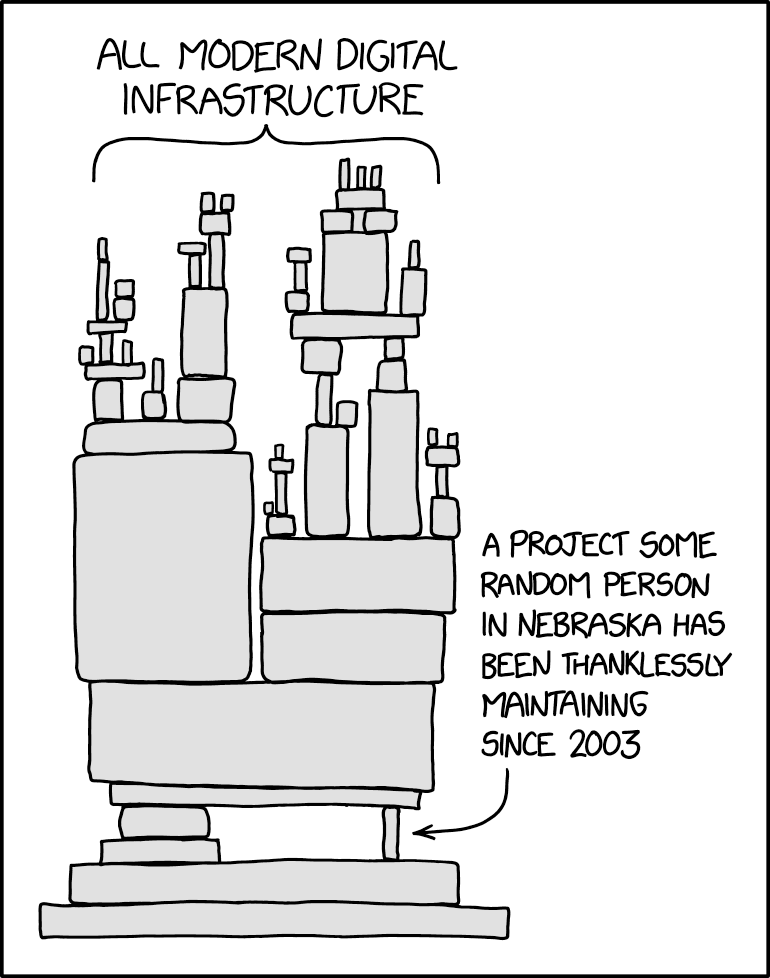
"Someday ImageMagick will finally break for good and we'll have a long period of scrambling as we try to reassemble civilization from the rubble."
Async Language Server Protocol plugin for vim8 and neovim.
ALE makes use of NeoVim and Vim 8 job control functions and timers to run linters on the contents of text buffers and return errors as text is changed in Vim. This allows for displaying warnings and errors in files being edited in Vim before files have been saved back to a filesystem.
In other words, this plugin allows you to lint while you type.
ALE offers support for fixing code with command line tools in a non-blocking manner with the :ALEFix feature, supporting tools in many languages, like prettier, eslint, autopep8, and more.
ALE acts as a "language client" to support a variety of Language Server Protocol features, including:
- Diagnostics (via Language Server Protocol linters)
- Go To Definition (:ALEGoToDefinition)
- Completion (Built in completion support, or with Deoplete)
- Finding references (:ALEFindReferences)
- Hover information (:ALEHover)
- Symbol search (:ALESymbolSearch)
If you don't care about Language Server Protocol, ALE won't load any of the code for working with it unless needed. One of ALE's general missions is that you won't pay for the features that you don't use.
Help Wanted: If you would like to help maintain this plugin by managing the many issues and pull requests that are submitted, please send the author an email at dev@w0rp.com.
If you enjoy this plugin, feel free to contribute or check out the author's other content at w0rp.com.

Pyright is a fast type checker meant for large Python source bases. It can run in a “watch” mode and performs fast incremental updates when files are modified.

Open source home automation that puts local control and privacy first. Powered by a worldwide community of tinkerers and DIY enthusiasts. Perfect to run on a Raspberry Pi or a local server.
SatNOGS project is a complete platform of a open satellite ground-station network. The scope of the project is to create a full stack of open technologies based on open standards , and the construction of a full ground station as a showcase of the stack.
SatNOGS provides the basis for:
- Bulk manufacturing and deployment of affordable Satellite Ground Stations
- Modular design for integration with existing and future technologies
- A platform for a variety of instrumentation around Satellite Ground Station operations
- A firm platform for a Ground Station collaborative network (one to one, one to many, many to many)
- A community based approach on Ground Station development
- A solution for massive automation of operator-less Ground Stations based on open standards
SatNOGS is a modular and scalable stack for Satellite Ground Station implementation. Fully based on open source technologies and open standards, it provides interoperability with existing or future subsystems.
A Global Management Network is the key part of our stack, connecting multiple observers with multiple ground stations enabling tracking and monitoring of satellites from multiple locations around the world. The data gathered will be publicly accessible through the network website.

@abstractmethod
def run(self, terms, variables=None, **kwargs):
"""
When the playbook specifies a lookup, this method is run. The
arguments to the lookup become the arguments to this method. One
additional keyword argument named variables is added to the method
call. It contains the variables available to ansible at the time the
lookup is templated. For instance::
"{{ lookup('url', 'https://toshio.fedorapeople.org/one.txt', validate_certs=True) }}"
would end up calling the lookup plugin named url's run method like this::
run(['https://toshio.fedorapeople.org/one.txt'], variables=available_variables, validate_certs=True)
Lookup plugins can be used within playbooks for looping. When this
happens, the first argument is a list containing the terms. Lookup
plugins can also be called from within playbooks to return their
values into a variable or parameter. If the user passes a string in
this case, it is converted into a list.
Errors encountered during execution should be returned by raising
AnsibleError() with a message describing the error.
Any strings returned by this method that could ever contain non-ascii
must be converted into python's unicode type as the strings will be run
through jinja2 which has this requirement. You can use::
from ansible.module_utils._text import to_text
result_string = to_text(result_string)
"""
pass

You should use Skeleton if you're embarking on a smaller project or just don't feel like you need all the utility of larger frameworks. Skeleton only styles a handful of standard HTML elements and includes a grid, but that's often more than enough to get started. In fact, this site is built on Skeleton and has ~200 lines of custom CSS (half of which is the docking navigation).
Love Skeleton and want to Tweet it, share it, or star it? Well, I appreciate that <3
This part of the documentation covers all the interfaces of Requests. For parts where Requests depends on external libraries, we document the most important right here and provide links to the canonical documentation.
PNG, JPG & SVG


PNG & SVG

Requests is an elegant and simple HTTP library for Python, built for human beings.
Requests allows you to send HTTP/1.1 requests extremely easily. There’s no need to manually add query strings to your URLs, or to form-encode your POST data. Keep-alive and HTTP connection pooling are 100% automatic, thanks to urllib3.
Beloved Features:
- Requests is ready for today’s web.
- Keep-Alive & Connection Pooling
- International Domains and URLs
- Sessions with Cookie Persistence
- Browser-style SSL Verification
- Automatic Content Decoding
- Basic/Digest Authentication
- Elegant Key/Value Cookies
- Automatic Decompression
- Unicode Response Bodies
- HTTP(S) Proxy Support
- Multipart File Uploads
- Streaming Downloads
- Connection Timeouts
- Chunked Requests
- .netrc Support
Requests officially supports Python 2.7 & 3.6+, and runs great on PyPy.

