Antmicro provides engineering services, open source tools, platforms and strategic R&D for high-tech products.

RIOT is an open-source microcontroller operating system, designed to match the requirements of Internet of Things (IoT) devices and other embedded devices. These requirements include a very low memory footprint (on the order of a few kilobytes), high energy efficiency, real-time capabilities, support for a wide range of low-power hardware, communication stacks for wireless and communication stacks for wired networks.
RIOT provides threading, multiple network stacks, and utilities which include cryptographic libraries, data structures (bloom filters, hash tables, priority queues), a shell and more. RIOT supports a wide range of microcontroller architectures, radio drivers, sensors, and configurations for entire platforms, e.g. Atmel SAM R21 Xplained Pro, Zolertia Z1, STM32 Discovery Boards etc. (see the list of supported boards. Across all supported hardware (32-bit, 16-bit, and 8-bit platforms), RIOT provides a consistent API and enables C and C++ application programming, with multithreading, IPC, system timers, mutexes etc.
A good high-level overview can be found in the article RIOT: An Open Source Operating System for Low-End Embedded Devices in the IoT (IEEE Internet of Things Journal, December 2018).

RIOT powers the Internet of Things like Linux powers the Internet. RIOT is a free, open source operating system developed by a grassroots community gathering companies, academia, and hobbyists, distributed all around the world.
RIOT supports most low-power IoT devices, microcontroller architectures (32-bit, 16-bit, 8-bit), and external devices. RIOT aims to implement all relevant open standards supporting an Internet of Things that is connected, secure, durable & privacy-friendly.

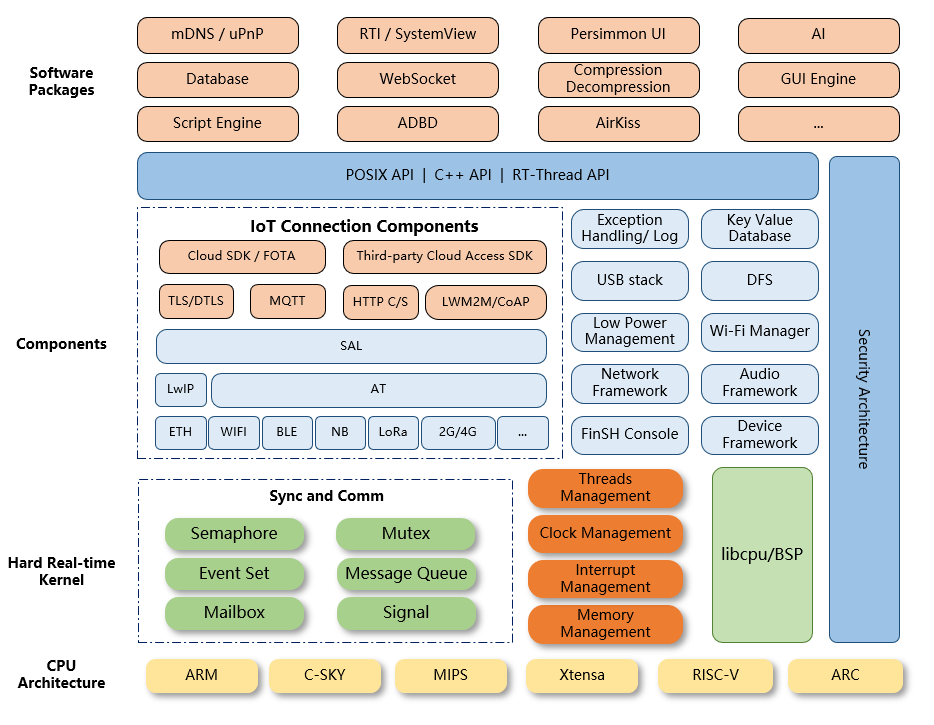
RT-Thread was born in 2006, it is an open source, neutral, and community-based real-time operating system (RTOS).
RT-Thread is mainly written in C language, easy to understand and easy to port(can be quickly port to a wide range of mainstream MCUs and module chips). It applies object-oriented programming methods to real-time system design, making the code elegant, structured, modular, and very tailorable.
RT-Thread has Standard version and Nano version. For resource-constrained microcontroller (MCU) systems, the Nano version that requires only 3KB Flash and 1.2KB RAM memory resources can be tailored with easy-to-use tools. For resource-rich IoT devices, RT-Thread can use the on-line software package management tool, together with system configuration tools, to achieve intuitive and rapid modular cutting, seamlessly import rich software packages; thus, achieving complex functions like Android's graphical interface and touch sliding effects, smart voice interaction effects, and so on.

The DroneBot Workshop is the place to be if you are interested in working with Arduino, Raspberry Pi, Electronics, Robotics, Internet of Things, Quadcopters and other high tech fun things. You'll learn how components work and how you can use them in your experiments, as well as fascinating projects you can build yourself.
NATS Server is a simple, high performance open source messaging system for cloud native applications, IoT messaging, and microservices architectures.
This is the ultimate IoT board with wired 100Mb Ethernet Interface, Bluetooth LE, WiFi, Remote control IR, and CAN connectivity. The board can operate with single LiPo backup battery like UPS as it has an internal LiPo battery charger and a step-up converter. Two relays allows you to switch power appliances on and off.
An OS to build, deploy and securely manage billions of devices