My home internet connection comes with proper dual-stack support. I get a public IPv4 address via DHCP, a /128 (IA_NA) and a /48 IPv6 prefix (IA_PD) via DHCPv6.
Traditionally you would configure your networking via iproute2 and then fork-off a DHCP client to configure the external addresses.
Usually all of that is being hidden from you through wrappers (like Debian’s ifupdown). The configuration would be set, the daemons fired off and hopefully everything would go well.
The limitations of the system become visible once you have a more dynamic set of interfaces that have to be initialized in some order, some VPN device that depend on the uplink connection etc. While systems like ifupdown have employed hooks of all sorts that you still end up writing a bunch of (inlined) shell scripts that deal with some little details of your setup. Adding sleep statements at worst. Things get tricky when one interface going up changes things on another interface or even system wide (think sysctl, iptables, starting a VPN daemon, …).


I decided to switch to NixOS on my router as part of my crusade to switch most of my devices to it. So, here is how I did it! This post is more or less a raw thought stream from during the setup process. It also resembles a tutorial - that is purely because it makes it easier for me to write, this isn't really intended as a tutorial, more as an explanation of what I did - you're free to use this as reference though!
This is a companion post to my discussion with Craig Andera on Relevance Podcast Episode 32 and my Clojure/West talk Clojure in the Large. I've talked about various bits and pieces of this workflow at other times, too, but I'll try to bring it all together here in the hopes that others will find it useful.
One of the great pleasures of working with a dynamic language is being able to build a system while simultaneously interacting with it. To make this possible, first you need the ability to redefine parts of the program while it is running: Clojure provides this capability admirably. However, some aspects of Clojure's runtime are not quite as late-binding as one might wish for interactive development. For example, the effect of a changed macro definition will not be seen until code which uses the macro has been recompiled. Changes to methods of a defrecord or deftype will not have any effect on existing instances of that type.

Many Powershell enthusiasts don't realize that when they are using commands like New-PsSession and streaming pipelines to a powershell runspace on a remote machine, they are actually writing a binary message wrapped in a SOAP envelope that leverages a protocol with the namesake of Windows Vista. Not much over a year ago I certainly wasn't. This set of knowledge all began with needing to transfer files from a linux machine to a windows machine. In a pure linux world there is a well known tool for this called SCP. In Windows we map drives or stream bytes to a remote powershell session. How do we get a file (or command for that matter) from one of these platforms to the other?
If Emacs’s editing model and keybindings are so atrocious, then why not reprogram it? Evil is an Emacs extension that implements Vim in Emacs. It’s been around for a while, and from what I can gather, it’s quite complete. You have all the basic editing commands, can define leader key combinations, the ex commands (the : prompt) are implemented. An advanced Vim user will probably find some things missing. If that’s you please do let me know what it is! I’ve been asking my Vimmy friends and so far haven’t gotten much concrete feedback.
For an upper intermediate user it seems Evil is more than good enough, and it’s only getting better.



A few years ago, a data engineer on r/ExperiencedDevs got drunk and wrote down everything he learned in 10 years of engineering. The original account is deleted, but the post captures something real — the kind of honesty you only get after a few glasses of wine. Preserving it here, typos and all.
Contains the language you’d expect from someone who opened with ‘I’m drunk’.

Sometimes, in a vast and healthy developer ecosystem of a language like Clojure, it can be difficult to know where to get started when you want to build an application. The target audience of this series is developers who have some Clojure syntax in their hands and want to start building applications.


Getting started with Kubernetes might seem like a daunting task at first, but getting a basic ephemeral cluster up and running with tools like minikube, kind, or k3d is quite straightforward if you follow their documentation.
In this article we’ll explore how to bootstrap a more permanent, or production grade, Kubernetes cluster using k3s. Other tools like kubeadm, k0s, microk8s, or kubespray (which uses kubeadm under the hood) are also available.


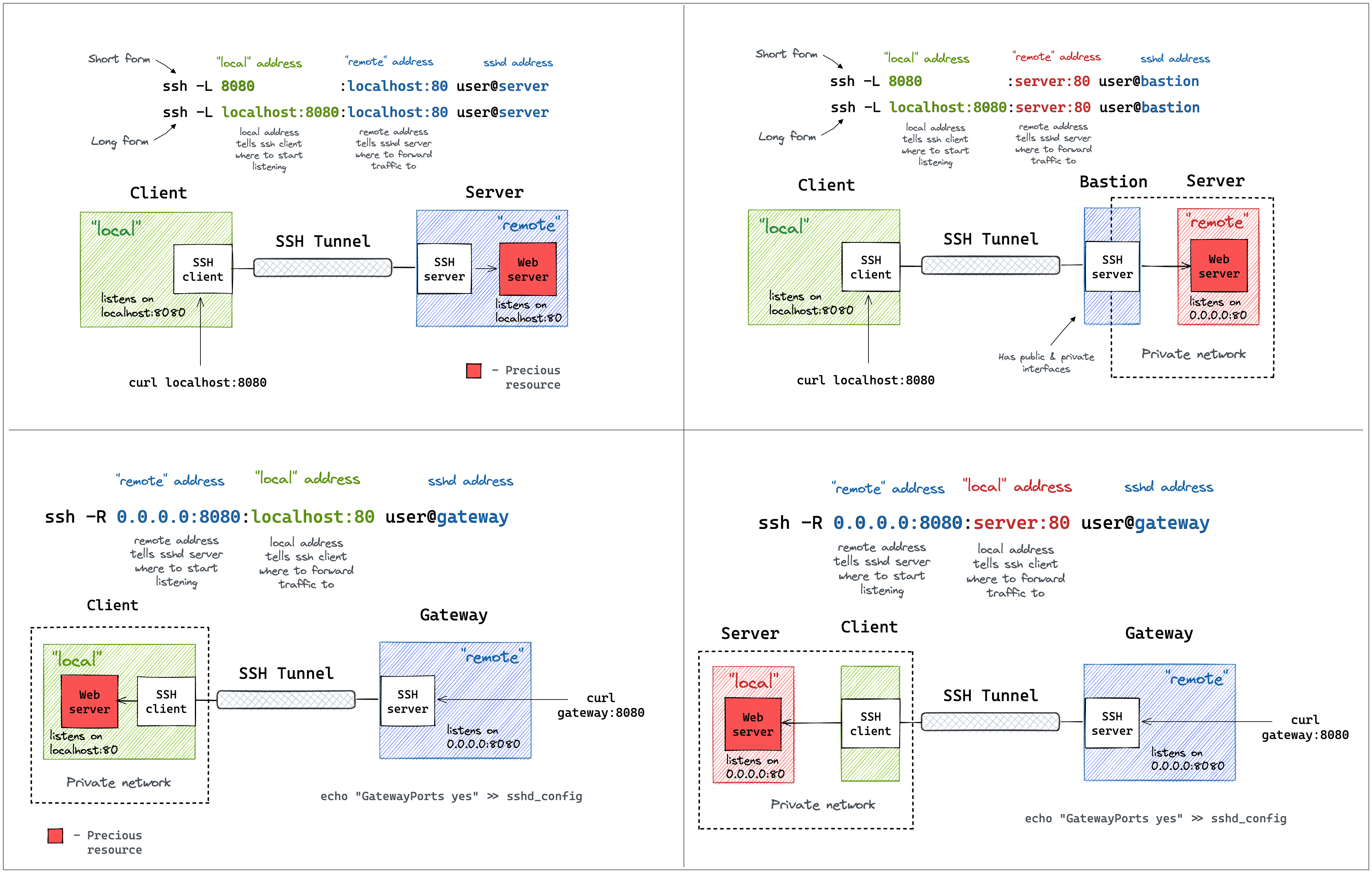
We’ve all seen these great diagrams of how SSH port forwarding works but if your brain is anything like mine, these diagrams leave you with a lot of unanswered questions. If you’re on a red team, understanding how to traverse a network better than the people who designed it gives you immense power to do evil things. SSH is such a powerful tool but sometimes the syntax and other concepts can get in the way of us accomplishing our goals. In an effort to do more evil things in a timely fashion I’ve put together a massive list of SSH things that I find useful. You can read it too, but if I’m being honest, this is mostly for me. I’ve learned that I really don’t grasp concepts unless I have hands on keyboard time doing them. This post is essentially just everything I learned while doing so. Also I should point out that in all of these examples I am using a websever to demonstrate port forwarding but this can be done with almost any service including RDP, SQL, etc.
I erase my systems at every boot.
Over time, a system collects state on its root partition. This state lives in assorted directories like /etc and /var, and represents every under-documented or out-of-order step in bringing up the services.
“Right, run myapp-init.”These small, inconsequential “oh, oops” steps are the pieces that get lost and don’t appear in your runbooks.
“Just download ca-certificates to … to fix …”Each of these quick fixes leaves you doomed to repeat history in three years when you’re finally doing that dreaded RHEL 7 to RHEL 8 upgrade.
“Oh, touch /etc/ipsec.secrets or the l2tp tunnel won’t work.”OAuth allows websites and services to share assets among users. It is widely accepted, but be aware of its vulnerabilities.
Since the beginning of distributed personal computer networks, one of the toughest computer security nuts to crack has been to provide a seamless, single sign-on (SSO) access experience among multiple computers, each of which require unrelated logon accounts to access their services and content. Although still not fully realized across the entire internet, myriad, completely unrelated websites can now be accessed using a single physical sign-on. You can use your password, phone, digital certificate, biometric identity, two-factor authentication (2FA) or multi-factor authentication (MFA) SSO solution to log onto one place, and not have to put in another access credential all day to access a bunch of others. We have OAuth to thank for much of it.
Welcome to the Git crash course for SVN users! This introduces you to Git based on your current Subversion knowledge. If you want to migrate your company from SVN to Git, see the SVN migration page. If you want a list of common commands, see the Git Cheat Sheet (or the git-svn guide if you are using Git as a subversion client. Many non-SVN-specific guides are also available. This crash course is based on Pasky's unmaintained version.

YAML (/ˈjæməl/) (see § History and name) is a human-readable data-serialization language. It is commonly used for configuration files and in applications where data is being stored or transmitted. YAML targets many of the same communications applications as Extensible Markup Language (XML) but has a minimal syntax which intentionally differs from Standard Generalized Markup Language (SGML).[1] It uses both Python-style indentation to indicate nesting, and a more compact format that uses [...] for lists and {...} for maps[1] thus JSON files are valid YAML 1.2.[2]
This text exists mainly so that I paste the URL into the #mysql channel in Libera IRC.
The mysqldump tools allows you to convert a MySQL database server or individual schemas back to SQL. You are left with a script that is supposed to be loadable into a target server and gives you back the full database, including all objects in it.

Ed25519 is a public-key signature system with several attractive features
How to quickly learn new programming languages and frameworks. Plus, an dive into HDFS and how it works.
When you insert data into a database and run COMMIT you expect things to be there: Atomically, Consistent, Isolated and Durable, like Codd commanded us 40 years ago, but also quickly. There is a surprising amount of sophistication being poured into this, but since I do not want to shame MongoDB and Redis developers in this post, I am not going to talk about that much in this place.
We are instead trying to understand what our databases are doing all day, from the point of view of the storage stack.
PCI Express (PCIe) has been around since 2003, and in that time it has managed to become the primary data interconnect for not only expansion cards, but also high-speed external devices. What also makes PCIe interesting is that it replaces the widespread use of parallel buses with serial links. Instead of having a bus with a common medium (traces) to which multiple devices connect, PCIe uses a root complex that directly connects to PCIe end points.
Amid all the conversation about Signal, and the debate over decentralization, one thing has often not been raised: all of these things require an Internet connection.
“Of course,” you might say. “Internet is everywhere these days.” Well, not so much, and it turns out there are some very good reasons that people might want messengers that work offline. Here are some examples:
- Internet-using messengers leak certain metadata (eg, that a person is using it, or perhaps a sophisticated adversary could use timing analysis to determine that two people are talking using it)
- Cell signal outages due to natural disaster, large influx of people (protests, unusual sporting events, festivals, etc), or other factors
- Locations where cell signals are not available (rural areas, camping locations, wilderness areas, etc.)
- Devices that don’t have cell data capability (many tablets, phones that have had service expire, etc.)