This article explains how to install a Samba v4 Active Directory domain controller in a Docker container. This post is part of my series on home automation, networking & self-hosting that shows how to install, configure, and run a home server with dockerized or virtualized services.

BlueChi (formerly known as hirte) is a deterministic multi-node service controller.
BlueChi can manage the states of different services across multiple nodes with a focus on highly regulated industries, such as those requiring functional safety. BlueChi integrates with systemd via its D-Bus API and relays D-Bus messages over TCP for multi-nodes support.
On the main node a service called bluechi-controller is running. On startup, the controller loads the configuration files which describe all the involved systems (called nodes) that are expected to be managed. Each node has a unique name that is used to reference it in the controller.
On each managed node that is under control of BlueChi a service called bluechi-agent is running. When the service starts, it connects (via D-Bus over TCP) to the controller and registers as available (optionally authenticating). It then receives requests from the controller and reports local state changes to it.
k3s ist eine schlanke Variante zum vollen Kubernetes (k8s) Stack. Der k3s Cluster lässt sich daher mit wenigen Schritten installieren und einrichten. Dieses Tutorial beschreibt dir wie du den k3s Cluster installieren kannst.
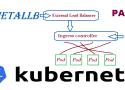
Running a Kubernetes Cluster in your own data center on Bare Metal hardware can be lots of fun but also can be challenging. One of the changeless are exposing your service to an external Load Balancer, Kubernetes does not offer an implementation of an external load-balancer for bare metal cluster implementations. The Kubernetes implementations of Network Load Balancers are only available on specific Cloud Providers like AWS, GCP, Azure, etc.. and is enabled by specifying the –cloud-provider= option. leaving a gap/challenge if you create your own Bare Metal Kubernetes Cluster. While their are many workarounds to address this issue most of them are not perfect and have their own list of challenges. while I was looking for a for a solution, most recently came across a project called MetalLB, at first I was quite sceptical if its going to work, but after testing this for a while I have to say, I am quite happy with the solution.
In this post we’ll look at how ingress works in a K3s cluster. For background, I recommend reading the Networking Section of the K3s documentation.
Ingress Overview
K3s automatically deploys the Traefik Ingress Controller and provides a service load balancer called Klipper.

OpenWISP is a modular network management system built on top of OpenWRT (but designed to allow supporting multiple embedded operating systems) that allows managing and automating several aspects of IT network deployment, monitoring and management:
- registration/provisioning of new nodes
- creation of VPN tunnels
- possibility of defining configuration templates and configuration variables to make the maintenance of configurations easier and faster
- possibility of configuring mesh networks as well as wireless access points using WPA2, WPA3, 802.1x (WPA enterprise) , WPS, WEP, multiple SSIDs, etc.
- possibility of deploying any network configuration supported by OpenWRT
- monitoring, collection of metrics, active checks, threshold definition and alerts
- RADIUS (eg: for wifi access / hotspot systems or ISPs)
- responsive captive page with features like user registration, SMS verification, social login
- firmware upgrades
- web and email notifications for important events happening in the network
- network topology visualization for mesh networks and VPN networks
The preceding list is not an exhaustive list but more like an overview of what OpenWISP can do.

Apache APISIX is a dynamic, real-time, high-performance API gateway.
APISIX provides rich traffic management features such as load balancing, dynamic upstream, canary release, circuit breaking, authentication, observability, and more.
You can use Apache APISIX to handle traditional north-south traffic, as well as east-west traffic between services. It can also be used as a k8s ingress controller.
Samba backups provide a way to recover your Samba AD domain, in the unlikely event that it suffers a catastrophic failure. It does not backup individual DCs.
One of the most popular SAS 6.0gbps/ SATA III controllers for enthusiasts is the IBM M1015. In its native form, it is a very capable host bus adapter (HBA) based on the LSI SAS2008 chip. With the low price on places such as ebay (see here for an ebay search for the M1015) and an enthusiastic community that has learned to unlock many features, it has quickly become a go-to choice for low-cost SATA III connectivity. This series of articles was written by Pieter Schaar perhaps best known as the one behind laptopvideo2go.com. He has been a regular contributor in the STH forums and has been detailing his learning in threads such as these. I do want to note that these modifications are not endorsed by this site, LSI, IBM or others and the information herein is purely for educational purposes. If you do encounter problems, you are solely responsible for those consequences.
StorCLI ist Nachfolger des MegaCLI und bietet Kommandozeilenwerkzeuge zur Verwaltung und Steuerung von MegaRAID Controllern. In diesem Artikel finden Sie eine Sammlung nützlicher Befehle zum Administrieren Ihres MegaRAID-Controllers.
Informationen zum MegaCLI zeigt der Artikel MegaRAID Controller mit MegaCLI verwalten. StorCLI unterstützt neben den neuen Kommandos zusätzlich auch die bisherige Syntax des MegaCLI.