This Clojure style guide recommends best practices so that real-world Clojure programmers can write code that can be maintained by other real-world Clojure programmers. A style guide that reflects real-world usage gets used, and a style guide that holds to an ideal that has been rejected by the people it is supposed to help risks not getting used at all — no matter how good it is.


Getting started
The spec library (API docs) specifies the structure of data, validates or conforms it, and can generate data based on the spec.

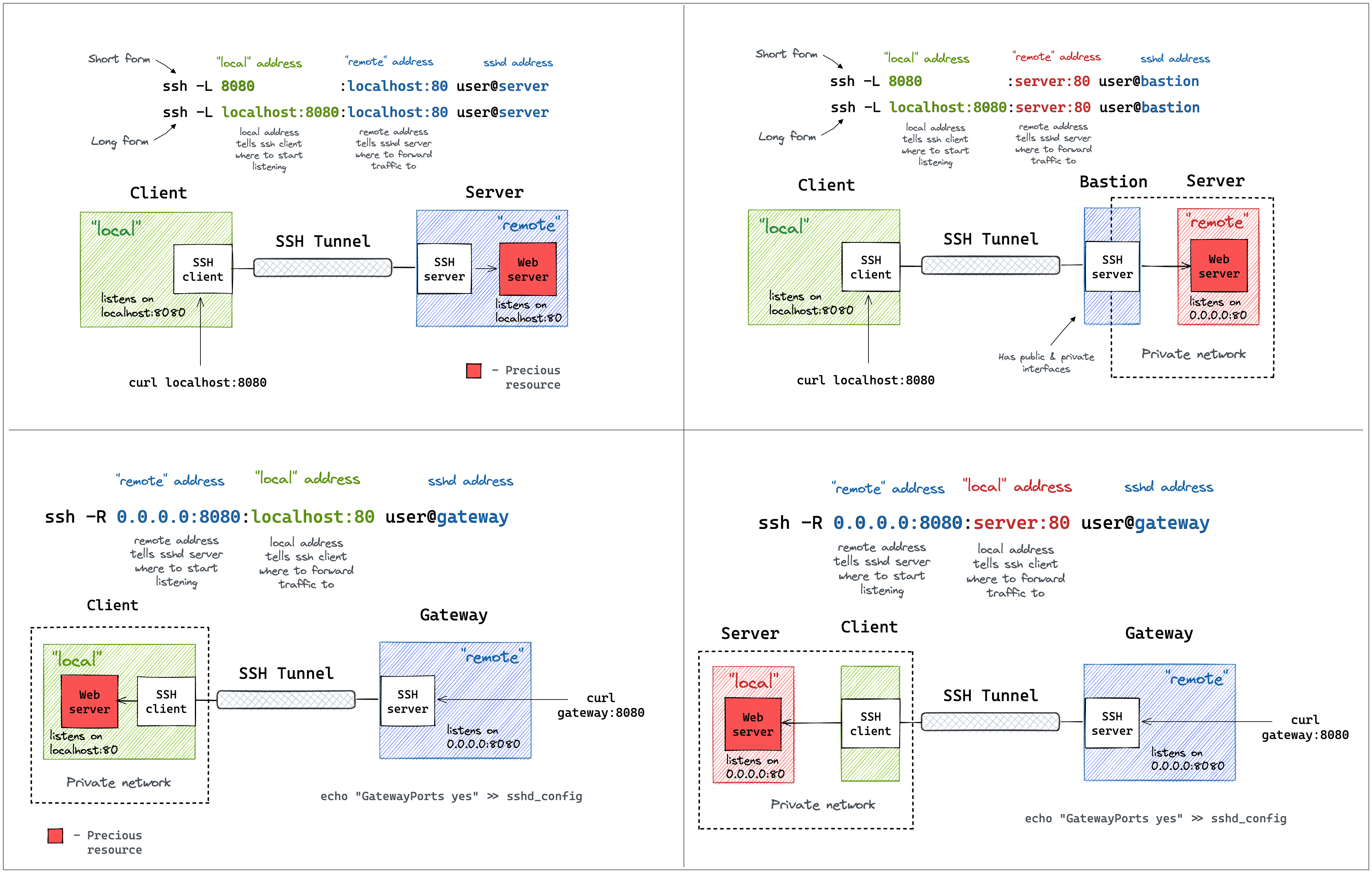
We’ve all seen these great diagrams of how SSH port forwarding works but if your brain is anything like mine, these diagrams leave you with a lot of unanswered questions. If you’re on a red team, understanding how to traverse a network better than the people who designed it gives you immense power to do evil things. SSH is such a powerful tool but sometimes the syntax and other concepts can get in the way of us accomplishing our goals. In an effort to do more evil things in a timely fashion I’ve put together a massive list of SSH things that I find useful. You can read it too, but if I’m being honest, this is mostly for me. I’ve learned that I really don’t grasp concepts unless I have hands on keyboard time doing them. This post is essentially just everything I learned while doing so. Also I should point out that in all of these examples I am using a websever to demonstrate port forwarding but this can be done with almost any service including RDP, SQL, etc.

Make every word matter
Welcome to the Microsoft Writing Style Guide, your guide to writing style and terminology for all communication—whether an app, a website, or a white paper. If you write about computer technology, this guide is for you.
Today, lots of people are called upon to write about technology. We need a simple, straightforward style guide that everyone can use, regardless of their role. And it needs to reflect Microsoft's modern approach to voice and style: warm and relaxed, crisp and clear, and ready to lend a hand.
Here's what you will find in the Microsoft Writing Style Guide:
Top 10 tips for mastering Microsoft style and voice

Bias-free communication

Global communicationsLet KeePassXC safely store your passwords and auto-fill them into your favorite apps, so you can forget all about them.
We do the heavy lifting in a no-nonsense, ad-free, tracker-free, and cloud-free manner. Free and open source.
This document is a guide for installing Arch Linux using the live system booted from an installation medium made from an official installation image. The installation medium provides accessibility features which are described on the page Install Arch Linux with accessibility options. For alternative means of installation, see Category:Installation process.
Before installing, it would be advised to view the FAQ. For conventions used in this document, see Help:Reading. In particular, code examples may contain placeholders (formatted in italics) that must be replaced manually.
This guide is kept concise and you are advised to follow the instructions in the presented order per section. For more detailed instructions, see the respective ArchWiki articles or the various programs' man pages, both linked from this guide. For interactive help, the IRC channel and the forums are also available.
Arch Linux should run on any x86_64-compatible machine with a minimum of 512 MiB RAM, though more memory is needed to boot the live system for installation.[1] A basic installation should take less than 2 GiB of disk space. As the installation process needs to retrieve packages from a remote repository, this guide assumes a working internet connection is available.

Vale is an open-source, command-line tool (, , and ) that brings your editorial style guide to life.
Pleroma is a free, federated social networking server built on open protocols. It is compatible with GNU Social, Mastodon, and many other ActivityPub implementations.
All currently supported Python versions (3.6+) support string-formatting via f-strings. While PEP 498 (Literal String Interpolation) as well as the Python documention (tutorial, syntax reference) have some information on their usage, I was missing a reference which is terse, but still verbose enough to explain the syntax.
I’ve been getting requests to create a modification guide for the T430 for over a year now, so this guide is long overdue. I’ve modded and created probably about a dozen T430 ThinkPads in the last 3 years and my mobile powerhouse is currently my fully decked out and customized T430. Every mod possible, my T430 has it, and I’ve opened up, disassembled, and reassembled the T430 so many times it makes my head spin thinking about it. So here we go, the definitive T430 modding guide.
Small, fast, modern HTTP server.
Cowboy is the ultimate server for the modern Web with support for Websocket, HTTP/2 and REST.
Welcome to the Python Packaging User Guide, a collection of tutorials and references to help you distribute and install Python packages with modern tools.
This guide is maintained on GitHub by the Python Packaging Authority. We happily accept any contributions and feedback. 😊
This document contains all the information you need to configure and use the i3 window manager. If it does not, please check https://www.reddit.com/r/i3wm/ first, then contact us on IRC (preferred) or post your question(s) on the mailing list.
This document provides introductory information on how DNSSEC works, how to configure BIND 9 to support some commonDNSSEC features, as well as some basic troubleshooting tips. The chapters are organized as such:
Chapter 1 covers the intended audience for this document, assumed background knowledge, and a basic introduction to
the topicof DNSSEC.
Chapter 2 covers various requirements that are needed before implementing DNSSEC, such as software
versions, hardwarecapacity, network requirements, and security changes.
Chapter 3 walks through setting up a validating resolver, more information on the validation process, as well as
examples ofusing tools to verify that the resolver is validating answers.
Chapter 4 walks through setting up a basic signed authoritative zone, explains the relationship with the parent zone,
and on-goingmaintenance tasks.
Chapter 5 provides some tips on how to analyze and diagnose DNSSEC-related problems.
Chapter 6 covers several topics, from key generation, key storage, key management, NSEC and NSEC3, to
disadvantages ofDNSSEC.
Chapter 7 provides several working examples of common solutions, with step-by-step details
This guide describes how to use the protocol buffer language to structure your protocol buffer data, including .proto file syntax and how to generate data access classes from your .proto files. It covers the proto2 version of the protocol buffers language: for information on the newer proto3 syntax, see the Proto3 Language Guide.
This is a reference guide – for a step by step example that uses many of the features described in this document, see the tutorial for your chosen language.
A minimalistic and focused guide with common use cases, patterns, principles and practises for developing Cloud Native applications on Kubernetes.
demo song "Guide Me Home" / "How Can I Go On"
Python is the main scripting language used at Google. This style guide is a list of dos and don'ts for Python programs.
To help you format code correctly, we've created a settings file for Vim[1]. For Emacs, the default settings should be fine.
[1] https://google.github.io/styleguide/google_python_style.vim