Partisan is a scalable and flexible, TCP-based membership system and distribution layer for the BEAM. It bypasses the use of Distributed Erlang for manual connection management via TCP, and has several pluggable backends for different deployment scenarios.
Partisan is a runtime system that enables greater scalability and reduced latency for distributed actor applications.
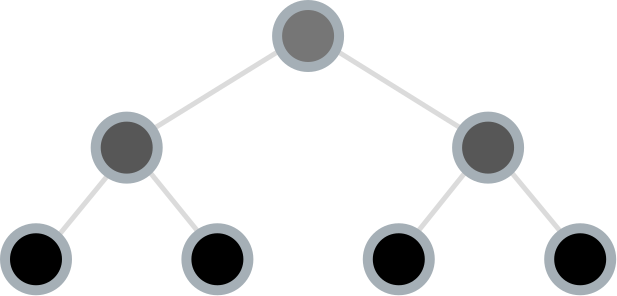
- Partisan improves scalability by allowing the application developer to specialize the overlay network to the application’s communication patterns.
- Partisan achieves lower latency by leveraging several predominately automatic optimizations that result in the efficient scheduling of messages.
- Bring Your Own Overlay - Partisan exposes an API for users to implement their own overlays; application developers must simply implement the membership_strategy interface for handling messages. Partisan automatically uses this membership strategy for processing incoming and outgoing messages to the system – the application developer only needs to handle internal state transitions and supplying the system with an updated list of members. Partisan automatically sets up required connections, serializes and deserializes messages, performs failure detection, and message forwarding. This makes it possible to implement protocols with very little code; our implementation of the full-mesh membership protocol is 152 LOC.
- Partisan is the first distributed actor system to expose this level of control to the application developer, improving the performance of existing actor application and enabling new types of actor applications.


An open-source implementation of the Messaging Layer Security protocol
OpenMLS is a software library that can serve as a building block in applications that require end-to-end encryption of messages.
It has a safe and easy-to-use interface that hides the complexity of the underlying cryptographic operations.
NAPALM (Network Automation and Programmability Abstraction Layer with Multivendor support) is a Python library that implements a set of functions to interact with different network device Operating Systems using a unified API.
NAPALM supports several methods to connect to the devices, to manipulate configurations or to retrieve data.
Six provides simple utilities for wrapping over differences between Python 2 and Python 3. It is intended to support codebases that work on both Python 2 and 3 without modification. six consists of only one Python file, so it is painless to copy into a project.
Six can be downloaded on PyPi. Its bug tracker and code hosting is on GitHub.
The name, “six”, comes from the fact that 2*3 equals 6. Why not addition? Multiplication is more powerful, and, anyway, “five” has already been snatched away by the (admittedly now moribund) Zope Five project.
The KiCad software tool come with an additional component library package and a documentation package. Once you install all three packages you are set with a full fledged software tool for PCB design. Any necessary PDF documentation will be then available from the Help menu of each KiCad application (Eeschema, Cvpcb, etc.). The same documentation is available here too.
KiCad is an EDA software suite for the creation of professional schematics and printed circuit boards up to 32 copper layers with additional technical layers. KiCad runs on Windows, Linux and Apple OS X and is released under the open-source GNU GPL v2 free of charge.
If you like KiCad or are making a good living using KiCad in your toolset, you should consider donating funds used for development. CERN has put up a place to collect donations which will be used directly to support a developer.