

What is Pingora
Pingora is a Rust framework to build fast, reliable and programmable networked systems.
Pingora is battle tested as it has been serving more than 40 million Internet requests per second for more than a few years.
Feature highlights
- Async Rust: fast and reliable
- HTTP 1/2 end to end proxy
- TLS over OpenSSL or BoringSSL
- gRPC and websocket proxying
- Graceful reload
- Customizable load balancing and failover strategies
- Support for a variety of observability tools
Getting started
See our quick starting guide to see how easy it is to build a load balancer.
Our user guide covers more topics such as how to configure and run Pingora servers, as well as how to build custom HTTP server and proxy logic on top of Pingora's framework.
API docs are also available for all the crates.

k3s ist eine schlanke Variante zum vollen Kubernetes (k8s) Stack. Der k3s Cluster lässt sich daher mit wenigen Schritten installieren und einrichten. Dieses Tutorial beschreibt dir wie du den k3s Cluster installieren kannst.
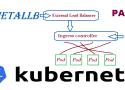
Running a Kubernetes Cluster in your own data center on Bare Metal hardware can be lots of fun but also can be challenging. One of the changeless are exposing your service to an external Load Balancer, Kubernetes does not offer an implementation of an external load-balancer for bare metal cluster implementations. The Kubernetes implementations of Network Load Balancers are only available on specific Cloud Providers like AWS, GCP, Azure, etc.. and is enabled by specifying the –cloud-provider= option. leaving a gap/challenge if you create your own Bare Metal Kubernetes Cluster. While their are many workarounds to address this issue most of them are not perfect and have their own list of challenges. while I was looking for a for a solution, most recently came across a project called MetalLB, at first I was quite sceptical if its going to work, but after testing this for a while I have to say, I am quite happy with the solution.
dnsdist is a highly DNS-, DoS- and abuse-aware loadbalancer. Its goal in life is to route traffic to the best server, delivering top performance to legitimate users while shunting or blocking abusive traffic.
dnsdist is dynamic, its configuration language is Lua and it can be changed at runtime, and its statistics can be queried from a console-like interface or an HTTP API.
MetalLB is a load-balancer implementation for bare metal Kubernetes clusters, using standard routing protocols.
Why?
Kubernetes does not offer an implementation of network load-balancers (Services of type LoadBalancer) for bare metal clusters. The implementations of Network LB that Kubernetes does ship with are all glue code that calls out to various IaaS platforms (GCP, AWS, Azure…). If you’re not running on a supported IaaS platform (GCP, AWS, Azure…), LoadBalancers will remain in the “pending” state indefinitely when created.
Bare metal cluster operators are left with two lesser tools to bring user traffic into their clusters, “NodePort” and “externalIPs” services. Both of these options have significant downsides for production use, which makes bare metal clusters second class citizens in the Kubernetes ecosystem.
MetalLB aims to redress this imbalance by offering a Network LB implementation that integrates with standard network equipment, so that external services on bare metal clusters also “just work” as much as possible.
Envoy is an L7 proxy and communication bus designed for large modern service oriented architectures. The project was born out of the belief that:
The network should be transparent to applications. When network and application problems do occur it should be easy to determine the source of the problem.dnsdist is a highly DNS-, DoS- and abuse-aware loadbalancer. Its goal in life is to route traffic to the best server, delivering top performance to legitimate users while shunting or blocking abusive traffic.
dnsdist is dynamic, its configuration language is Lua and it can be can be changed at runtime, and its statistics can be queried from a console-like interface or an HTTP API.
A configuration to balance DNS queries to several backend servers:
The Pound program is a reverse proxy, load balancer and HTTPS front-end for Web server(s). Pound was developed to enable distributing the load among several Web-servers and to allow for a convenient SSL wrapper for those Web servers that do not offer it natively. Pound is distributed under the GPL - no warranty, it's free to use, copy and give away.
WHAT POUND IS:
a reverse-proxy: it passes requests from client browsers to one or more back-end servers.
a load balancer: it will distribute the requests from the client browsers among several back-end servers, while keeping session information.
an SSL wrapper: Pound will decrypt HTTPS requests from client browsers and pass them as plain HTTP to the back-end servers.
an HTTP/HTTPS sanitizer: Pound will verify requests for correctness and accept only well-formed ones.
a fail over-server: should a back-end server fail, Pound will take note of the fact and stop passing requests to it until it recovers.
a request redirector: requests may be distributed among servers according to the requested URL.
Pound is a very small program, easily audited for security problems. It can run as setuid/setgid and/or in a chroot jail. Pound does not access the hard-disk at all (except for reading the certificate file on start, if required) and should thus pose no security threat to any machine.
User and Reference Manual
Command Set BalanceNG V3 (3.608) and higher