So I’m about to teach you a bunch of tricks for efficiently tunneling whatever you want over seemingly innocuous openings in a customer’s firewall. These tricks will culminate with the most cursed trick of all, which is tunneling inbound SSH connections inside of outbound HTTPS requests. This will grant you full command-line access to your on-premises hosts using the most benign firewall permission that a customer can grant. Moreover, this post is accompanied by a repository named holepunch containing NixOS modules automating this ultimate trick which you can either use directly or consult as a working proof-of-concept for how the trick works.



What is Pingora
Pingora is a Rust framework to build fast, reliable and programmable networked systems.
Pingora is battle tested as it has been serving more than 40 million Internet requests per second for more than a few years.
Feature highlights
- Async Rust: fast and reliable
- HTTP 1/2 end to end proxy
- TLS over OpenSSL or BoringSSL
- gRPC and websocket proxying
- Graceful reload
- Customizable load balancing and failover strategies
- Support for a variety of observability tools
Getting started
See our quick starting guide to see how easy it is to build a load balancer.
Our user guide covers more topics such as how to configure and run Pingora servers, as well as how to build custom HTTP server and proxy logic on top of Pingora's framework.
API docs are also available for all the crates.
The open internet is a great place to code, but sometimes you are sitting behind a great firewall in a corporate environment. Your are not allowed to just pull the hottest stuff from the internet, but have to go through an internal binary artifact repository like nexus or artifactory.
-- Ralf D. Müller, Groovy enthusiast, arc42 contributor, docToolchain maintainer


Welcome
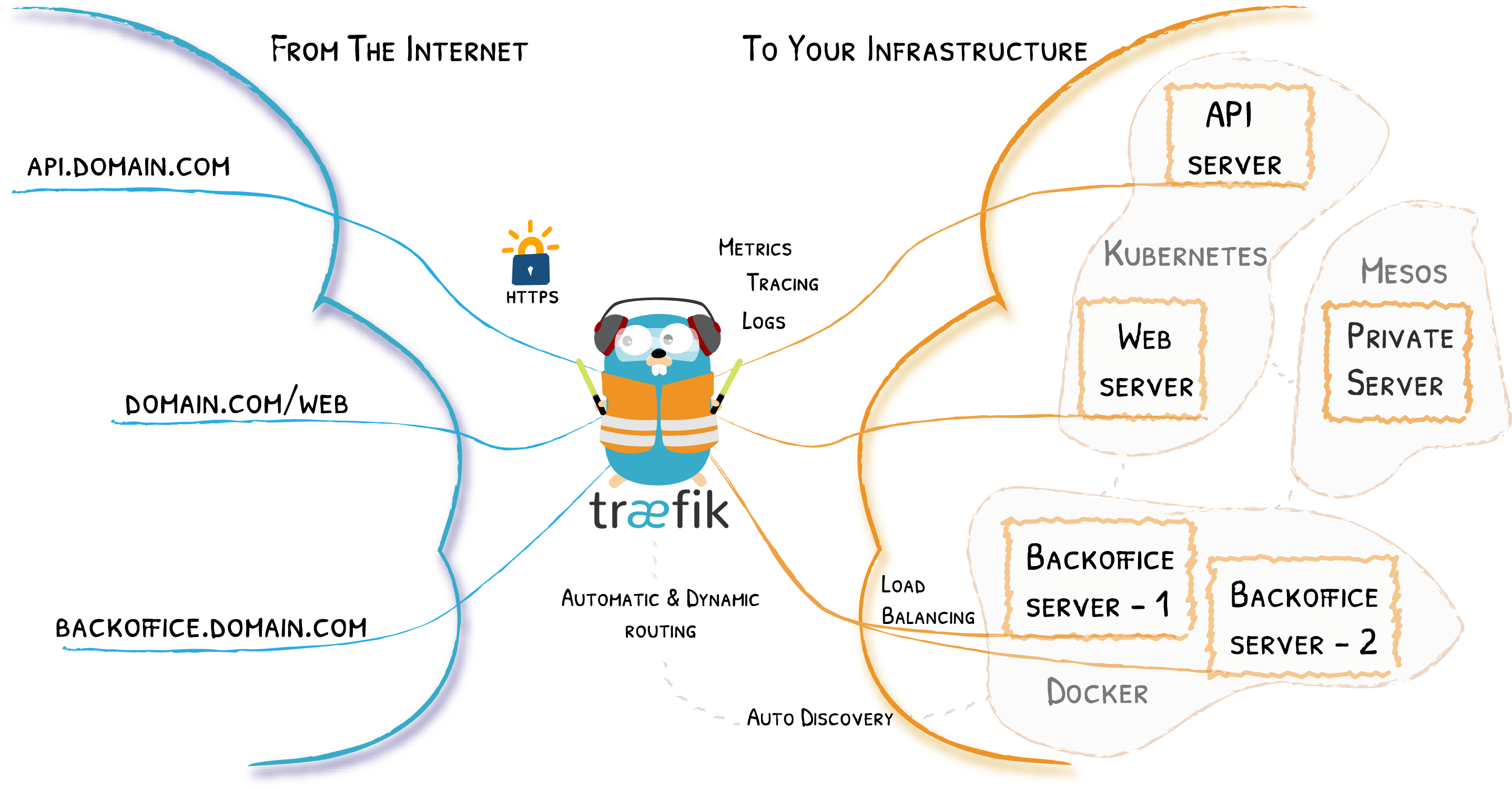
Traefik is an open-source Edge Router that makes publishing your services a fun and easy experience. It receives requests on behalf of your system and finds out which components are responsible for handling them.
What sets Traefik apart, besides its many features, is that it automatically discovers the right configuration for your services. The magic happens when Traefik inspects your infrastructure, where it finds relevant information and discovers which service serves which request.
Traefik is natively compliant with every major cluster technology, such as Kubernetes, Docker, Docker Swarm, AWS, Mesos, Marathon, and the list goes on; and can handle many at the same time. (It even works for legacy software running on bare metal.)
With Traefik, there is no need to maintain and synchronize a separate configuration file: everything happens automatically, in real time (no restarts, no connection interruptions). With Traefik, you spend time developing and deploying new features to your system, not on configuring and maintaining its working state.
Developing Traefik, our main goal is to make it simple to use, and we're sure you'll enjoy it.
HAProxy is a free, very fast and reliable reverse-proxy offering high availability, load balancing, and proxying for TCP and HTTP-based applications. It is particularly suited for very high traffic web sites and powers a significant portion of the world's most visited ones. Over the years it has become the de-facto standard opensource load balancer, is now shipped with most mainstream Linux distributions, and is often deployed by default in cloud platforms. Since it does not advertise itself, we only know it's used when the admins report it :-)
The HAProxy core team maintains multiple versions in parallel. Since version 1.8, two major version are emitted every year. The first digit usually indicates a breaking change (config format etc) but in practice rarely changes. The second digit indicates new features. Both constitute a branch. One extra number appears after these digits to indicate the bug fix release.
Fabio is an HTTP and TCP reverse proxy that configures itself with data from Consul.
Traditional load balancers and reverse proxies need to be configured with a config file. The configuration contains the hostnames and paths the proxy is forwarding to upstream services. This process can be automated with tools like consul-template that generate config files and trigger a reload.
Fabio works differently since it updates its routing table directly from the data stored in Consul as soon as there is a change and without restart or reloading.
When you register a service in Consul all you need to add is a tag that announces the paths the upstream service accepts, e.g. urlprefix-/user or urlprefix-/order and fabio will do the rest.
Envoy is an L7 proxy and communication bus designed for large modern service oriented architectures. The project was born out of the belief that:
The network should be transparent to applications. When network and application problems do occur it should be easy to determine the source of the problem.Poolmon is a director mailserver pool monitoring script for Dovecot, meant to
roughly duplicate the functionality of node health monitors on dedicated load-
balancers like LVS or F5 BigIP LTM. This script can be safely run on more than
one director host simultaneously, although differences in node reachability may
result in mailserver vhost count flapping.
Consult the help text for more details on functionality.
The Pound program is a reverse proxy, load balancer and HTTPS front-end for Web server(s). Pound was developed to enable distributing the load among several Web-servers and to allow for a convenient SSL wrapper for those Web servers that do not offer it natively. Pound is distributed under the GPL - no warranty, it's free to use, copy and give away.
WHAT POUND IS:
a reverse-proxy: it passes requests from client browsers to one or more back-end servers.
a load balancer: it will distribute the requests from the client browsers among several back-end servers, while keeping session information.
an SSL wrapper: Pound will decrypt HTTPS requests from client browsers and pass them as plain HTTP to the back-end servers.
an HTTP/HTTPS sanitizer: Pound will verify requests for correctness and accept only well-formed ones.
a fail over-server: should a back-end server fail, Pound will take note of the fact and stop passing requests to it until it recovers.
a request redirector: requests may be distributed among servers according to the requested URL.
Pound is a very small program, easily audited for security problems. It can run as setuid/setgid and/or in a chroot jail. Pound does not access the hard-disk at all (except for reading the certificate file on start, if required) and should thus pose no security threat to any machine.