
RT-Thread was born in 2006, it is an open source, neutral, and community-based real-time operating system (RTOS).
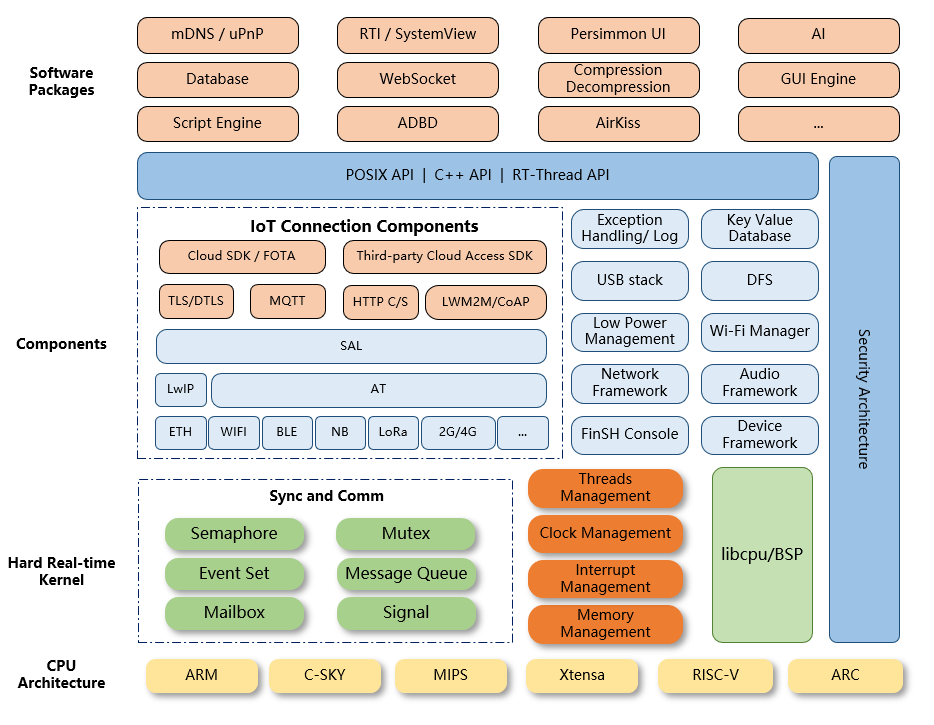
RT-Thread is mainly written in C language, easy to understand and easy to port(can be quickly port to a wide range of mainstream MCUs and module chips). It applies object-oriented programming methods to real-time system design, making the code elegant, structured, modular, and very tailorable.
RT-Thread has Standard version and Nano version. For resource-constrained microcontroller (MCU) systems, the Nano version that requires only 3KB Flash and 1.2KB RAM memory resources can be tailored with easy-to-use tools. For resource-rich IoT devices, RT-Thread can use the on-line software package management tool, together with system configuration tools, to achieve intuitive and rapid modular cutting, seamlessly import rich software packages; thus, achieving complex functions like Android's graphical interface and touch sliding effects, smart voice interaction effects, and so on.


ist of open source real-time operating systems
NuttX is a real-time operating system (RTOS) with an emphasis on standards compliance and small footprint. Scalable from 8-bit to 32-bit microcontroller environments, the primary governing standards in NuttX are Posix and ANSI standards. Additional standard APIs from Unix and other common RTOS's (such as VxWorks) are adopted for functionality not available under these standards, or for functionality that is not appropriate for deeply-embedded environments (such as fork()).
NuttX was first released in 2007 by Gregory Nutt under the permissive BSD license.
Developed in partnership with the world's leading chip companies over a 12 year period, FreeRTOS is the market leading real time operating system (or RTOS), and the de-facto standard solution for microcontrollers and small microprocessors.
With millions of deployments in all market sectors, blue chip companies trust FreeRTOS because it is professionally developed, strictly quality controlled, robust, supported, free to use in commercial products without a requirement to expose proprietary source code, and has no IP infringement risk.