
Signal messaging library for Python using Presage (Rust).
Docs for bleeding edge master can be found at https://docs.helix-editor.com/master.
See the usage section for a quick overview of the editor, keymap section for all available keybindings and the configuration section for defining custom keybindings, setting themes, etc. For everything else (e.g., how to install supported language servers), see the Helix Wiki.
Refer the FAQ for common questions.

83 languages for you to master
Become fluent in your chosen programming languages by completing these tracks created by our awesome team of contributors
Ladybird is a new browser engine built from scratch. Not a fork. No user monetization. Backed by a 501(c)(3) non-profit.

cljrs is an experimental Clojure dialect targeting the Rust ecosystem. It aims to be a capable Lisp runtime with persistent data structures, a hosted macro system, and native interop — compiled or interpreted, suitable for use as an agentic coding runtime.
Available on crates.io. Early stage; expect rough edges.
- Introduction - clojurust
clojurust is a Rust-hosted dialect of the Clojure programming language. It reads and executes .cljrs and
.cljc source files, provides an interactive REPL, and can AOT-compile programs to standalone native
binaries. - GitHub - csm/clojurust: Clojure and Rust · GitHub



Conjure is an interactive environment for evaluating code within your running program.
The core features of Conjure are language agnostic (although it’s targeted at Lisps for now), with each language client providing their own extra tools. Here’s the currently supported languages, contributions and 3rd party plugins that add clients are highly encouraged! You can find a comparison table for all clients and supported features in the wiki.


This docs/ directory is the documentation “source of truth” that lives alongside the code and evolves with it.
- Start with SUMMARY.md as the navigation spine.
- Add pages incrementally; the structure is designed to work well with future tooling (mdBook, Zola, Docusaurus, etc.).


A graph database built for data that matters. Temporal, verifiable, standards-compliant.
Fluree stores data as RDF triples with complete history, integrated search, and fine-grained access control — in a single binary with no external dependencies.
Billions of triples on commodity hardware. Over 2M triples/second bulk import. Benchmark leader across 105 W3C SPARQL queries.


This version of the text assumes you’re using Rust 1.85.0 (released 2025-02-17) or later with edition = "2024" in the Cargo.toml file of all projects to configure them to use Rust 2024 Edition idioms. See the “Installation” section of Chapter 1 for instructions on installing or updating Rust, and see Appendix E for information on editions.
The HTML format is available online at https://doc.rust-lang.org/stable/book/ and offline with installations of Rust made with rustup; run rustup doc --book to open.
Several community translations are also available.
This website is an experiment by the Cognitive Engineering Lab at Brown University. The goal of this experiment is to evaluate and improve the content of the Rust Book to help people learn Rust more effectively.
🦀

This project is a lightweight authentication server that provides an opinionated, simplified LDAP interface for authentication. It integrates with many backends, from KeyCloak to Authelia to Nextcloud and more!
Screenshot of the user list page
It comes with a frontend that makes user management easy, and allows users to edit their own details or reset their password by email.
The goal is not to provide a full LDAP server; if you're interested in that, check out OpenLDAP. This server is a user management system that is:
- simple to setup (no messing around with slapd),
- simple to manage (friendly web UI),
- low resources,
- opinionated with basic defaults so you don't have to understand the subtleties of LDAP.
It mostly targets self-hosting servers, with open-source components like Nextcloud, Airsonic and so on that only support LDAP as a source of external authentication.
For more features (OAuth/OpenID support, reverse proxy, ...) you can install other components (KeyCloak, Authelia, ...) using this server as the source of truth for users, via LDAP.
By default, the data is stored in SQLite, but you can swap the backend with MySQL/MariaDB or PostgreSQL.



What is Pingora
Pingora is a Rust framework to build fast, reliable and programmable networked systems.
Pingora is battle tested as it has been serving more than 40 million Internet requests per second for more than a few years.
Feature highlights
- Async Rust: fast and reliable
- HTTP 1/2 end to end proxy
- TLS over OpenSSL or BoringSSL
- gRPC and websocket proxying
- Graceful reload
- Customizable load balancing and failover strategies
- Support for a variety of observability tools
Getting started
See our quick starting guide to see how easy it is to build a load balancer.
Our user guide covers more topics such as how to configure and run Pingora servers, as well as how to build custom HTTP server and proxy logic on top of Pingora's framework.
API docs are also available for all the crates.
BoringTun is an implementation of the WireGuard® protocol designed for portability and speed.

A collection of lints to catch common mistakes and improve your Rust code.
There are over 700 lints included in this crate!
Lints are divided into categories, each with a default lint level. You can choose how much Clippy is supposed to annoy help you by changing the lint level by category.

Ferrocene is the main Rust compiler - rustc - but quality managed and qualified for use in automotive and industrial environments (currently by ISO 26262 and IEC 61508) by Ferrous Systems. It operates as a downstream to the Rust project, further increasing its testing and quality on specific platforms. We will publish further detailed blog posts on the components and changes in Ferrocene in the coming weeks.
All changes we made to increase the quality of the Rust compiler have already made it to the main Rust project upstream. See Pietro’s blog post for more details.

Alternative implementation of the Bitwarden server API written in Rust and compatible with upstream Bitwarden clients*, perfect for self-hosted deployment where running the official resource-heavy service might not be ideal.
Basically full implementation of Bitwarden API is provided including:
- Organizations support
- Attachments and Send
- Vault API support
- Serving the static files for Vault interface
- Website icons API
- Authenticator and U2F support
- YubiKey and Duo support
- Emergency Access

An open-source implementation of the Messaging Layer Security protocol
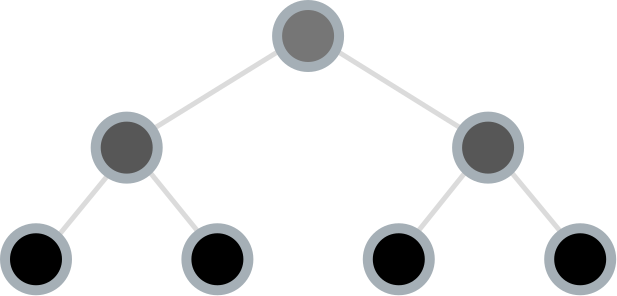
OpenMLS is a software library that can serve as a building block in applications that require end-to-end encryption of messages.
It has a safe and easy-to-use interface that hides the complexity of the underlying cryptographic operations.