
Missionary is a reactive dataflow programming toolkit providing referentially transparent operators for lazy continuous signals, eager discrete streams, and IO actions. Missionary aims to improve over state-of-the-art reactive systems, it can be used as a general-purpose asynchronous programming toolkit but also as a basis for event streaming and incremental computations.



SeaweedFS is a fast distributed storage system for blobs, objects, files, and data lake, for billions of files! Blob store has O(1) disk seek, cloud tiering. Filer supports Cloud Drive, xDC replication, Kubernetes, POSIX FUSE mount, S3 API, S3 Gateway, Hadoop, WebDAV, encryption, Erasure Coding. Enterprise version is at seaweedfs.com.

Xous is a microkernel operating system with processes, threads, and messages. It is designed to have an extremely small kernel that delegates as much as possible to userspace. This book describes the operating system kernel as well as the services that support normal operating system behavior.
As this book is a work in progress, some chapters are placeholders and will appear blank.
The book is written for two audiences: kernel maintainers, and application developers.
-
Chapters 2 (Server Architecture),
- 3 (Introducing the Kernel), and
- 5 (System Startup) are primarily for kernel maintainers and system programmers.
-
Chapters 1 (Getting Started),
- 4 (Renode Emulation),
- 6 (Build System Overview),
- 7 (Messages) and
- 8 (Graphics) are more appropriate for application developers.
-
Chapter 9 (PDDB) covers the Plausibly Deniable DataBase, and has sub-sections for both kernel and application developers.

Partisan is a scalable and flexible, TCP-based membership system and distribution layer for the BEAM. It bypasses the use of Distributed Erlang for manual connection management via TCP, and has several pluggable backends for different deployment scenarios.
Partisan is a runtime system that enables greater scalability and reduced latency for distributed actor applications.
- Partisan improves scalability by allowing the application developer to specialize the overlay network to the application’s communication patterns.
- Partisan achieves lower latency by leveraging several predominately automatic optimizations that result in the efficient scheduling of messages.
- Bring Your Own Overlay - Partisan exposes an API for users to implement their own overlays; application developers must simply implement the membership_strategy interface for handling messages. Partisan automatically uses this membership strategy for processing incoming and outgoing messages to the system – the application developer only needs to handle internal state transitions and supplying the system with an updated list of members. Partisan automatically sets up required connections, serializes and deserializes messages, performs failure detection, and message forwarding. This makes it possible to implement protocols with very little code; our implementation of the full-mesh membership protocol is 152 LOC.
- Partisan is the first distributed actor system to expose this level of control to the application developer, improving the performance of existing actor application and enabling new types of actor applications.


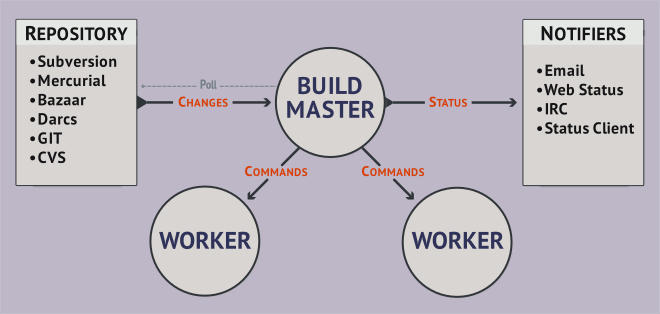
At its core, Buildbot is a job scheduling system: it queues jobs, executes the jobs when the required resources are available, and reports the results.
Your Buildbot installation has one or more masters and a collection of workers. The masters monitor source-code repositories for changes, coordinate the activities of the workers, and report results to users and developers. Workers run on a variety of operating systems.
You configure Buildbot by providing a Python configuration script to the master. This script can be very simple, configuring built-in components, but the full expressive power of Python is available. This allows dynamic generation of configuration, customized components, and anything else you can devise.
The framework itself is implemented in Twisted Python, and compatible with all major operating systems.

The CERN Tape Archive (CTA) is the archival storage system for the custodial copy of all physics data at CERN. CTA is implemented as the tape back-end to EOS. EOS+CTA is the CERN archival solution for LHC Run–3 and beyond.
For a general overview of CTA, see our Publications and Presentations. There is also some general Development and Systems Integration Documentation which complements what is on this site.

Bats is a TAP-compliant testing framework for Bash. It provides a simple way to verify that the UNIX programs you write behave as expected.
A Bats test file is a Bash script with special syntax for defining test cases. Under the hood, each test case is just a function with a description.
100% Kompatibilität für über 300 Maschinen in der 18-Volt-Klasse!
Da passt alles zu allem: Jetzt kannst Du Maschinen, Akkupacks und Ladegeräte unterschiedlichster Hersteller problemlos miteinander kombinieren
Zuul is a Project Gating System. That’s like a CI or CD system, but the focus is on testing the future state of code repositories.
A gating system doesn’t just test a proposed change; it tests the proposed future state of multiple branches and repositories with any number of in-flight changes and their dependencies. And the same playbooks used to test software can also be used to deploy it.
Zuul itself is a service which listens to events from various code review systems, executes jobs based on those events, and reports the results back to the code review system. The primary interface for Zuul is the code review system (or systems) so that it fits seamlessly into developer workflows, and a web interface is available for inspecting the current status and browsing build results.
The best way to run Zuul is with a single installation serving as many projects or groups as possible. It is a multi-tenant application that is able to provide as much or as little separation between projects as desired.
A tool to monitor I/O latency in real time. It shows disk latency in the same way as ping shows network latency.
Homepage: https://github.com/koct9i/ioping/ (migrated from http://code.google.com/p/ioping/)
Please send your patches, issues and questions to https://github.com/koct9i/ioping/issues/
A flexible and powerful static content management system for building complex and beautiful websites out of flat files — for people who do not want to make a compromise between a CMS and a static blog engine.
Getting your ideas implemented is as easy as frying an egg.
You might have already heard of a 10x engineer. Probably too often, actually. If there's such a thing as a 10x engineer, surely there must be a 1x engineer, too?
Of course there is! Let's dig into a non-exhaustive list of what qualities make up a 1x engineer.
Häufig ist auf herkömmlichen Android-Geräten eine Menge an Bloatware vorinstalliert – also Apps die man nicht braucht und gerne loswerden möchte. Viele Nutzer glauben man bräuchte dazu Root-Rechte. Dem ist allerdings nicht so. Ihr müsst lediglich den sog. Developer-Mode (Entwickleroptionen) aktivieren und euer Android-Gerät via USB-Kabel mit dem PC verbinden. Danach könnt ihr euer System über die Android Debug Bridge (adb) ansprechen.
Introducing Talos™ II
Talos™ II — the world's first computing system to support the new PCIe 4.0 standard — also boasts substantial DDR4 memory, dual POWER9 CPUs, next-generation security, and a price that won't break the bank. Let the power of Talos™ II accelerate your computing!
Git environment wrapper for managing and documenting changes. Make ''git blame'' on your system.
- CLT 1017 - Viele Admins verderben den Brei https://chemnitzer.linux-tage.de/2017/de/programm/beitrag/319
Apache Pulsar is an open-source distributed pub-sub messaging system originally created at Yahoo and now part of the Apache Software Foundation
NuttX is a real-time operating system (RTOS) with an emphasis on standards compliance and small footprint. Scalable from 8-bit to 32-bit microcontroller environments, the primary governing standards in NuttX are Posix and ANSI standards. Additional standard APIs from Unix and other common RTOS's (such as VxWorks) are adopted for functionality not available under these standards, or for functionality that is not appropriate for deeply-embedded environments (such as fork()).
NuttX was first released in 2007 by Gregory Nutt under the permissive BSD license.
Anchor is an ephemeral PKI service that, based on certain conditions, automates the verification of CSRs and signs certificates for clients. The validity period can be set in the config file with hour resolution.
Developed in partnership with the world's leading chip companies over a 12 year period, FreeRTOS is the market leading real time operating system (or RTOS), and the de-facto standard solution for microcontrollers and small microprocessors.
With millions of deployments in all market sectors, blue chip companies trust FreeRTOS because it is professionally developed, strictly quality controlled, robust, supported, free to use in commercial products without a requirement to expose proprietary source code, and has no IP infringement risk.