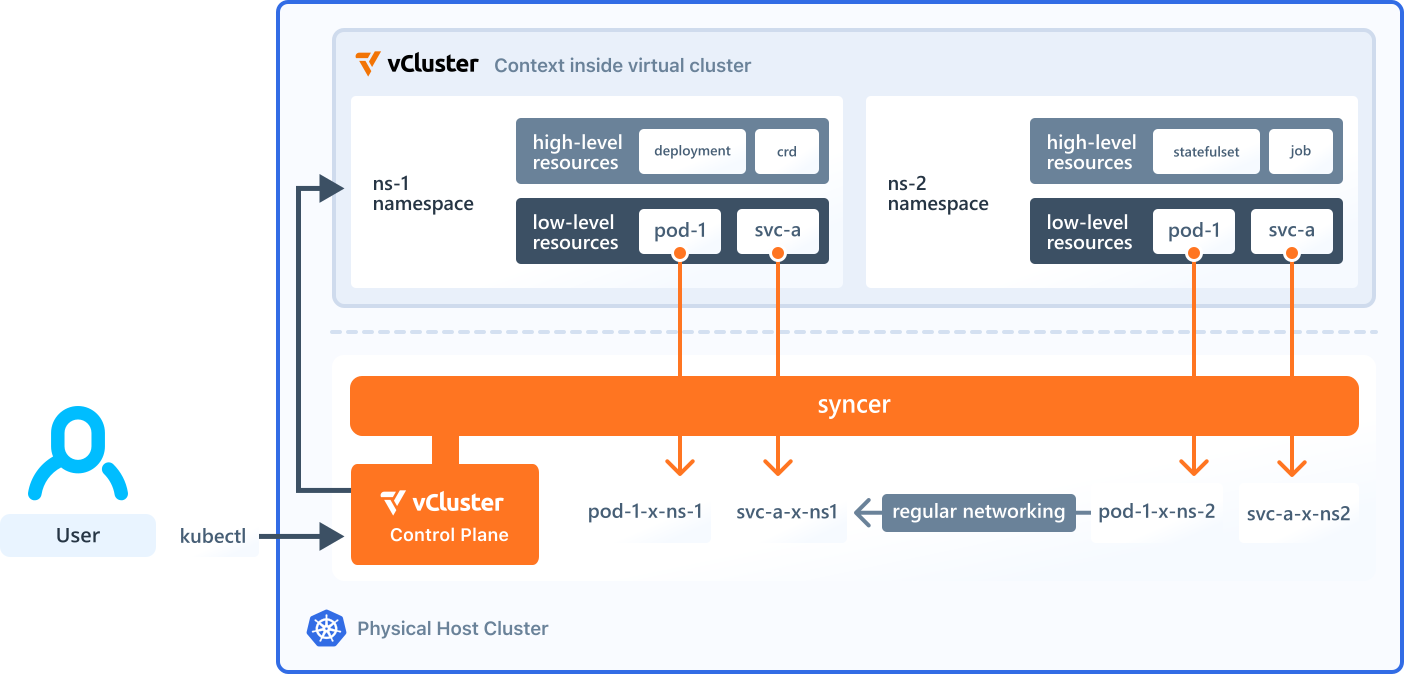
Virtual clusters are fully working Kubernetes clusters that run on top of other Kubernetes clusters. Compared to fully separate "real" clusters, virtual clusters do not have their own node pools. Instead, they are scheduling workloads inside the underlying cluster while having their own separate control plane.

Cluster API is a Kubernetes sub-project focused on providing declarative APIs and tooling to simplify provisioning, upgrading, and operating multiple Kubernetes clusters.
Started by the Kubernetes Special Interest Group (SIG) Cluster Lifecycle, the Cluster API project uses Kubernetes-style APIs and patterns to automate cluster lifecycle management for platform operators. The supporting infrastructure, like virtual machines, networks, load balancers, and VPCs, as well as the Kubernetes cluster configuration are all defined in the same way that application developers operate deploying and managing their workloads. This enables consistent and repeatable cluster deployments across a wide variety of infrastructure environments.
As the Top 5 corporate committer to the Kubernetes Project, we believe that open source communities develop better software to the benefit of all. We stand behind what we believe by actively contributing to upstream Kubernetes, cloud native technologies, and other projects that facilitate the adoption of multicloud operations. We are happy to get in touch to exchange ideas and learn from each other!
Kubermatic KubeOne automates cluster operations on all your cloud, on-prem, edge, and IoT environments. It comes as a CLI that allows you to manage the full lifecycle of your clusters, including installing and provisioning, upgrading, repairing, and unprovisioning your Kubernetes clusters.
Kubernetes has become the de-facto industry standard for container orchestration. It provides the required abstraction for efficiently managing large-scale containerized applications with declarative configurations, an easy deployment mechanism, and both scaling and self-healing capabilities.
As with any system, logs help engineers gain observability into containers and the Kubernetes clusters they’re running on and the key role they play is evident in a lot of incidents featuring Kubernetes failures. Yet Kubernetes poses a set of unique logging challenges.

Longhorn implements distributed block storage using containers and microservices. Longhorn creates a dedicated storage controller for each block device volume and synchronously replicates the volume across multiple replicas stored on multiple nodes. The storage controller and replicas are themselves orchestrated using Kubernetes.
Features
- Enterprise-grade distributed block storage with no single point of failure
- Incremental snapshot of block storage
- Backup to secondary storage (NFS or S3-compatible object storage) built on efficient change block detection
- Recurring snapshots and backups
- Automated, non-disruptive upgrades. You can upgrade the entire Longhorn software stack without disrupting running storage volumes.
- An intuitive GUI dashboard
In the past, ITOps and DevOps have found it hard to add replicated storage to Kubernetes clusters. As a result many non-cloud-hosted Kubernetes clusters don’t support persistent storage. External storage arrays are non-portable and can be extremely expensive.
Longhorn delivers simplified, easy to deploy and upgrade, 100% open source, cloud-native persistent block storage without the cost overhead of open core or proprietary alternatives.
Flux is a tool that automatically ensures that the state of a cluster matches the config in git. It uses an operator in the cluster to trigger deployments inside Kubernetes, which means you don't need a separate CD tool. It monitors all relevant image repositories, detects new images, triggers deployments and updates the desired running configuration based on that (and a configurable policy).
The benefits are: you don't need to grant your CI access to the cluster, every change is atomic and transactional, git has your audit log. Each transaction either fails or succeeds cleanly. You're entirely code centric and don't need new infrastructure.

Heute läuft der Server mit Ubuntu 20.04. Darauf laufen keine LXC/LXD Container mehr. Stattdessen läuft jetzt Kubernetes darauf. Zu Beginn nutzte ich für die Installation von Kubernetes Kubespray ein, das Standard-Kubernetes war allerdings deutlich zu fett. Größtes Manko war, dass das etcd verdammt viel auf die SSD geschrieben hat und ich regelmäßig bei jedem Upgrade das Setup kaputt gespielt habe. Für den Privatgebrauch ergab das so daher keinen Sinn.
Mittlerweile setze ich auf das vergleichsweise schlanke k3s.io. Das braucht im Heimbetrieb deutlich weniger Leistung und erledigt trotzdem das, was ich brauche. Statt etcd setzt es auf sqlite und statt Docker auf containerd.

If you have questions, check the documentation at kubespray.io and join us on the kubernetes slack, channel #kubespray. You can get your invite here
Can be deployed on AWS, GCE, Azure, OpenStack, vSphere, Packet (bare metal), Oracle Cloud Infrastructure (Experimental), or Baremetal
Highly available cluster
Composable (Choice of the network plugin for instance)
Supports most popular Linux distributions
Continuous integration testsThe certified Kubernetes distribution built for IoT & Edge computing
For production deployments, it is best practice that each plane runs on dedicated physical or virtual hosts. For development, multi-tenancy may be used to simplify management and reduce costs.
Velero is a backup and restore solution for Kubernetes, that can be used to take backups and restore them in case of loss but also for migrating to other clusters.
Authors:
Jie Yu <jie@mesosphere.io> (@jieyu)
Saad Ali <saadali@google.com> (@saad-ali)
James DeFelice <james@mesosphere.io> (@jdef)
container-storage-interface-working-group@googlegroups.comThe Kubernetes implementation of the Container Storage Interface (CSI) has been promoted to GA in the Kubernetes v1.13 release. Support for CSI was introduced as alpha in Kubernetes v1.9 release, and promoted to beta in the Kubernetes v1.10 release.
The GA milestone indicates that Kubernetes users may depend on the feature and its API without fear of backwards incompatible changes in future causing regressions. GA features are protected by the Kubernetes deprecation policy.
This article provides you a simple solution of how to setup a Kubernetes on multiple nodes using a tool called Ansible.
I really had no idea what I was getting into when I decided to build a Kubernetes Pi cluster, or if it would even work. The response on Twitter was absolutely overwhelming and flattering too! As promised, I've decided to document my findings so that anyone/everyone can enjoy the same setup.

Infrastructure as Code (IaC) is changing the way that we’re doing things. Some people think that it’s the motorway that we have to follow and be aligned with business, as a resume they want us to be agile.
The arrival of tools such as Ansible, Puppet, SaltStack, and Chef, have enabled sysadmins to maintain modular, automatable infrastructure. This time I would like to introduce the Terraform tool.
Terraform is a provisioning declarative tool that is based on the Infrastructure as Code paradigm. Terraform is a multipurpose composition tool: it composes multiple tiers (SaaS/PaaS/IaaS).
Terraform is not a cloud agnostic tool, but in combination with OpenNebula, it can be amazing. By taking advantage of the template concept it will allow us to deploy vm’s agnostically in different cloud providers, such as AWS, Azure or on premise cloud infrastructure.
Rootless containers refers to the ability for an unprivileged user to create, run and otherwise manage containers. This term also includes the variety of tooling around containers that can also be run as an unprivileged user. The goal of this website is to catalogue all of the open questions and unresolved issues that need to be solved to bring us closer to rootless containers “for all”.
“Unprivileged user” in this context refers to a user who does not have any administrative rights, and is “not in the good graces of the administrator” (in other words, they do not have the ability to ask for more privileges to be granted to them, or for software packages to be installed).