



Molecule project is designed to aid in the development and testing of Ansible roles.
Molecule provides support for testing with multiple instances, operating systems and distributions, virtualization providers, test frameworks and testing scenarios.
Molecule encourages an approach that results in consistently developed roles that are well-written, easily understood and maintained.
Molecule supports only the latest two major versions of Ansible (N/N-1), meaning that if the latest version is 2.9.x, we will also test our code with 2.8.x.
Once installed, the command line can be called using any of the methods below:
molecule ...
python3 -m molecule ...  # python module calling method


Previously named OpenTF, OpenTofu is a fork of Terraform that is open-source, community-driven, and managed by the Linux Foundation.

- PlantUML Theme 'none':
Showing posts with label PlantUML

The open internet is a great place to code, but sometimes you are sitting behind a great firewall in a corporate environment. Your are not allowed to just pull the hottest stuff from the internet, but have to go through an internal binary artifact repository like nexus or artifactory.
-- Ralf D. Müller, Groovy enthusiast, arc42 contributor, docToolchain maintainer


Prebuilt OpenJDK
Binaries for Free!
Java™ is the world's leading programming language and platform. The Adoptium Working Group promotes and supports high-quality, TCK certified runtimes and associated technology for use across the Java ecosystem. Eclipse Temurin is the name of the OpenJDK distribution from Adoptium.

Asciidoctor-ConfluencePublisher is a command line tool that parse asciidoc files, generate confluence compatible html and upload the content and attachment to confluence.
This repo inspired by confluence-publisher
It requires Ruby 2.x. works for Confluence 6+.
The Confluence Publisher allows documentation written in AsciiDoc and versioned directly with the documented code base to be published to a Confluence space. It converts the resulting AsciiDoc HTML output to XHTML compatible with Confluence, manages included resources as Confluence attachments and ensures that only content modified since the last publication is again re-published.
The Confluence Publisher has been tested with Confluence 6.0.5Supported Features
Currently, the Confluence Publisher supports the following AsciiDoc features:
- Pages
- Includes
- Sections
- Paragraphs
- Tables
- Images
- Listings
- Admonitions
- External Links
- PlantUML
- Attachments
- Table of Contents
- Additional Features
The Confluence Publisher uses AsciidoctorJ and therefore supports documentation written using the Asciidoctor syntax. See Asciidoctor User Manual for more information about Asciidoctor.
The primary goal of this project is to simplify the generation of an up-to-date RESTful API documentation by combining documentation that’s been hand-written with auto-generated API documentation produced by Swagger. The result is intended to be an up-to-date, easy-to-read, on- and offline user guide, comparable to GitHub’s API documentation. The output of Swagger2Markup can be used as an alternative to swagger-ui and can be served as static content.
NOTE: The Swagger Specification has been donated to to the Open API Initiative (OAI) and has been renamed to the OpenAPI Specification.
Swagger2Markup converts a Swagger JSON or YAML file into several AsciiDoc or GitHub Flavored Markdown documents which can be combined with hand-written documentation. The Swagger source file can be located locally or remotely via HTTP. Swagger2Markup supports the Swagger 1.2 and 2.0 specification. Internally it uses the official swagger-parser and my markup-document-builder.
You can use Swagger2Markup to convert your contract-first Swagger YAML file into a human-readable format and combine it with hand-written documentation. As an alternative, you can choose the code-first approach and use Swagger2Markup together with Swagger JAX-RS, springfox or spring-restdocs. If you are Gradle or Maven user, you can also use the Swagger2Markup Gradle Plugin or Swagger2markup Maven Plugin.
AsciiDoc is preferable to Markdown as it has more features. AsciiDoc is a text document format for writing documentation, articles, books, ebooks, slideshows, web pages and blogs. AsciiDoc files can be converted to HTML, PDF and EPUB. AsciiDoc is much better suited for describing public APIs than JavaDoc or Annotations.
You can generate your HTML5, PDF and EPUB documentation via asciidoctorj or even better via the asciidoctor-gradle-plugin or asciidoctor-maven-plugin.
The project requires at least JDK 8.
This page is a catalog of Asciidoctor extensions. In this context, an extension is a library that enriches the AsciiDoc content either by introducing new syntax or weaving additional features into the output. This differs from tool extensions, such as the Atom extension, which bring AsciiDoc support to the tool.
PlantUML is a component that allows you to quickly write:
-
Sequence diagram
@startuml
Alice -> Bob: Authentication Request
Bob --> Alice: Authentication Response
Alice -> Bob: Another authentication Request
Alice <-- Bob: Another authentication Response
@enduml
-
Usecase diagram
-
Class diagram
-
Object diagram
-
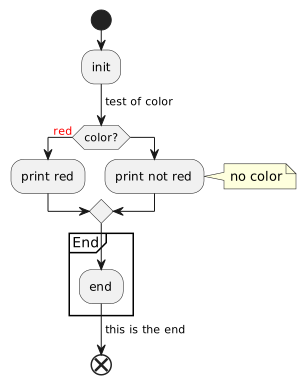
Activity diagram (here is the legacy syntax)
-
Component diagram
-
Deployment diagram
-
State diagram
-
Timing diagram
GitHub - plantuml/plantuml: Generate diagrams from textual description
Official Javadoc Documentation: Overview (plantuml 1.2024.7beta2 API)


If you need to convert files from one markup format into another, pandoc is your swiss-army knife. Pandoc can convert documents in markdown, reStructuredText, textile, HTML, DocBook, LaTeX, MediaWiki markup, TWiki markup, OPML, Emacs Org-Mode, Txt2Tags, Microsoft Word docx, EPUB, or Haddock markup to
HTML formats: XHTML, HTML5, and HTML slide shows using Slidy, reveal.js, Slideous, S5, or DZSlides.
Word processor formats: Microsoft Word docx, OpenOffice/LibreOffice ODT, OpenDocument XML
Ebooks: EPUB version 2 or 3, FictionBook2
Documentation formats: DocBook, GNU TexInfo, Groff man pages, Haddock markup
Page layout formats: InDesign ICML
Outline formats: OPML
TeX formats: LaTeX, ConTeXt, LaTeX Beamer slides
PDF via LaTeX
Lightweight markup formats: Markdown, reStructuredText, AsciiDoc, MediaWiki markup, DokuWiki markup, Emacs Org-Mode, Textile
Custom formats: custom writers can be written in lua.
A fast text processor & publishing toolchain for converting AsciiDoc to HTML5, DocBook & more.
AsciiDoc is a plain text markup language for writing technical content. It’s packed with semantic elements and equipped with features to modularize and reuse content. AsciiDoc content can be composed using a text editor, managed in a version control system, and published to multiple output formats.
